Thursday, March 19, 2015

Edges Part II - Benchmade Nimravus

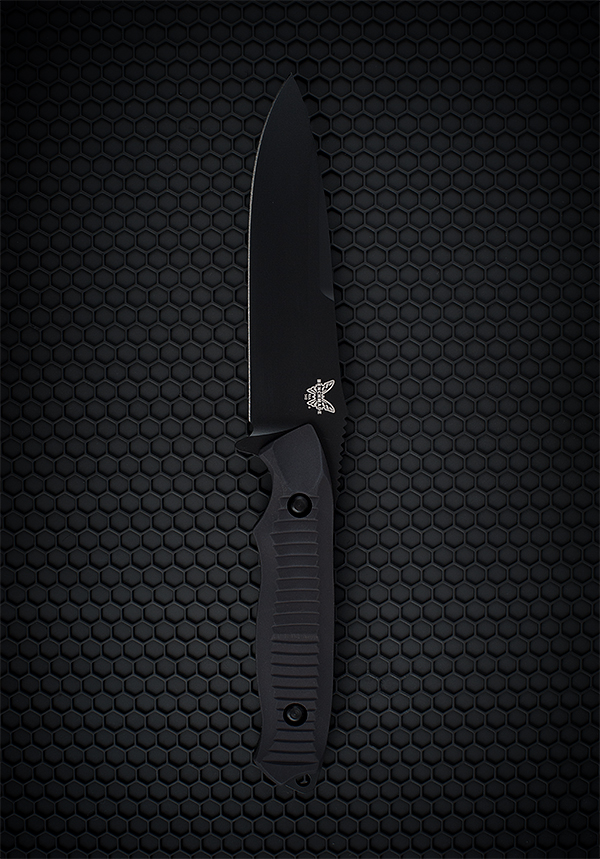
Next up on my list of current favorites is the BenchmadeNimravus 140BK, which is a mid-sized knife that comes with a versatile nylon sheath. I really like the blade design as an all-around camp knife, because it's thin and very light with a drop point that makes it excellent for slicing and puncturing.

When you pick up the Nimravus, it's much lighter than you would expect for its size. The blade length is 4.5" and overall the knife is 9.45" long, yet it only weighs about 6 oz. The unique aluminum handle scales contribute to this effect, and I like the handle although it can tend to feel cold during frigid temperatures with bare hands. There is a heavy choil and handle carve-out for the index finger along with very aggressive jimping along the back of the blade which combine to provide a lot of control.

As a slicing design the blade makes short work of food preparation, cord/rope cutting, creating wood shavings for kindling, fish cleaning, and so forth. The blade is thin enough that it works for filleting and it's also a great steak knife. It's not a heavy-duty chopper so you won't want to take it out and use it to baton or hack off tree limbs. Those types of tasks clearly necessitate ANOTHER KNIFE OR KNIVES which we will get to in subsequent posts.

Benchmade Nimravus Blog Size

When I want a jack-of-all-trades camp knife that can easily be attached to a belt or pack without adding noticeable weight, the Nimravus is my go-to.

Saturday, March 14, 2015

Edges Part I - Southern Grind Rat

Like most sportsmen, I have a few knives. By "a few" I mean that slight shifts in the bottom layers of my collection often cause tremors which are mistaken for seismic activity at our local university's geology department.

The issue is that, much like with fly rods or shotguns, there happens to be an ideal tool for certain types of jobs. In turn, this necessitates the ownership of a specific product to best meet the demands of the task at hand. Mathematicians have worked out the exact number of cutting implements required by the modern sportsman, and represent that figure as follows:

∞

This is often mispronounced by those in close association with an outdoorsman as "a bazillion," as in "I don't see why you need a bazillion knives." It's OK to gently correct the speaker in these cases and let them know that while "a bazillion" does tend to represent a large, exaggerated number, in this case the proper term is "infinity."

In the coming days I'm going to share some of my favorite fixed blades that I've been able to use over the past year.

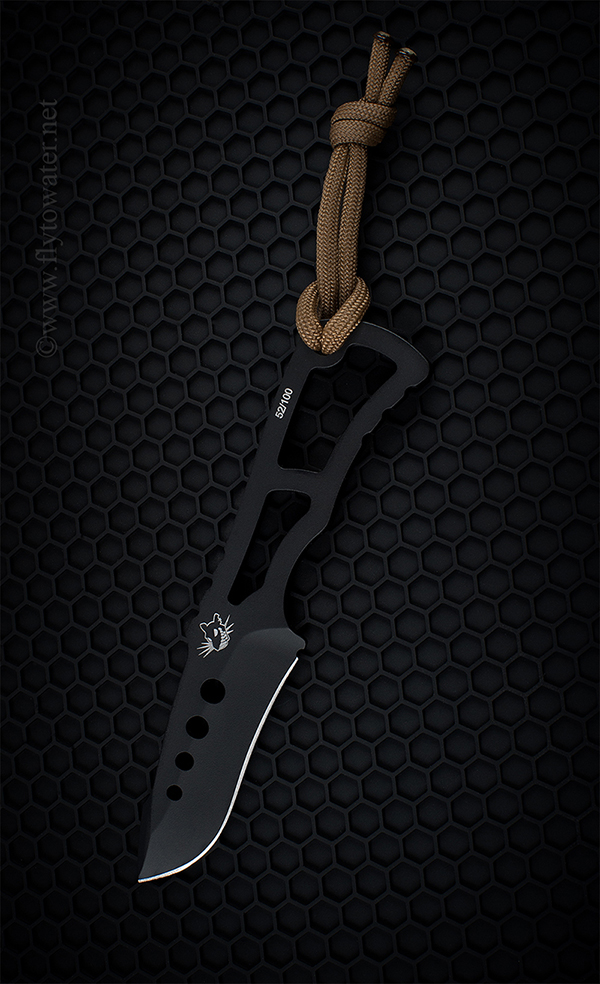
First up is the Southern Grind Rat. At only 4.9 inches in overall length and 1.5 ounces in weight, the Rat is incredibly useful for stowing unobtrusively in packs or pockets. It comes with a great little Kydex sheath that can be attached wherever you see fit or be worn around the neck. While small, this knife is actually very capable and can be pressed into service for most cutting tasks. You won't be using it for chopping kindling or anything heavy duty, but it's got a really nice flat grind and the 8670M high carbon steel takes an edge well. The finish is Cerakote and holds up nicely under use.

Southern Grind Rat - Blog Size

Where I use The Rat most often is as a backup that occupies virtually no space and stays in my day pack all the time. It also works perfectly for when you are traveling light and want a just-in-case knife that won't interfere with anything else you're bringing along.

Southern Grind fixed blades are not mass produced, so availability can be limited but at the time of this writing they are in stock both in tanto and drop point configurations.

Monday, September 29, 2014

First Aid in the Field

A few years ago, in what amounts to a freak accident, a highly experienced outdoorsman I am acquainted with found himself in a remote area with a hunting broadhead stuck clean through his upper arm. The situation quickly became life-threatening as he was alone and had minimal first-aid equipment. After a harrowing experience everything turned out okay, but the scenario caused me to reflect on the supplies I carry into the backcountry.

While what happened above took place due to unlikely and unforeseeable circumstances, potentially serious wounds and injuries are not uncommon in the field.

Over time I have put together a fairly compact and easily portable first-aid solution that has worked well for me off the beaten path and I thought some readers might be interested in an overview.

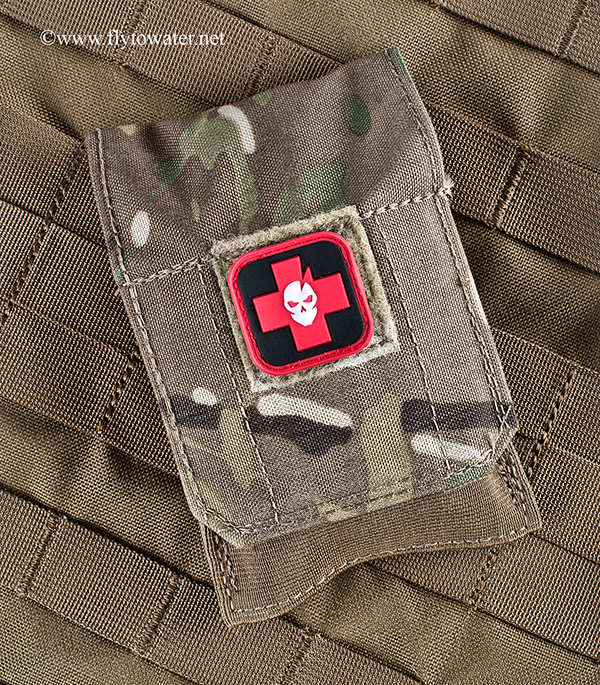
Imminent Threat Solutions ETA Trauma Kit

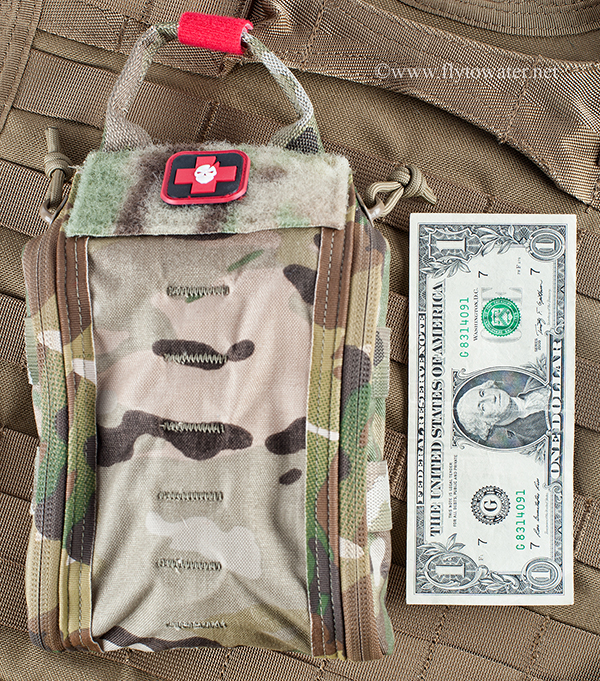
I started with an ETA kit designed by Imminent Threat Solutions to treat the 3 leading causes of preventable death due to injury: Extremity hemorrhage (E), tension pneumothorax (T), and airway obstruction (A). Of these, extremity hemorrhage is the most common during recreational activities. This is essentially a "blowout kit" designed for combat, but it contains solid fundamentals. It also comes in a well-designed pouch complete with PALS webbing such that it can be easily attached to just about anything using the supplied MALICE clips. Inside the standard kit you will find:

  • QuikClot Combat Gauze LE (1)
  • HALO Chest Seal (2)
  • MojoDart Decompression Needle (1)
  • Nasopharyngeal Airway (NPA) Adj. 28fr (1)
  • Pressure Dressing (1 — 4″)
  • Elastic Bandage (1 — 2″)
  • Z-Fold Dressing (1)
  • Combat Casualty Card (1)
  • Nitrile Gloves (1 Pair)
  • Pencil (1)

Even if you don't feel comfortable using the NPA or MojoDart, these items take up very little space and could potentially be used by a first responder if needed. The ETA can be ordered in a vacuum-sealed, waterproof package separately from the trauma kit pouch, making for a nice addition to whatever pack you already carry.

I like the webbed pouches because my daypack (Kifaru Scout) is already equipped with PALS, and I can attach the trauma kit anywhere I like. There are a variety of fishing, field, and photography packs designed with PALS/MOLLE that make this a versatile solution. As one example, the Smithfly 1x Pouch happens to fit the vacuum-packed fatboy trauma kit perfectly as well.

While this is a good start, there are a few additional components I like to have with me. First is a SOF Tactical Tourniquet which can be deployed very quickly, used with one hand, and also doubles as a pressure dressing.

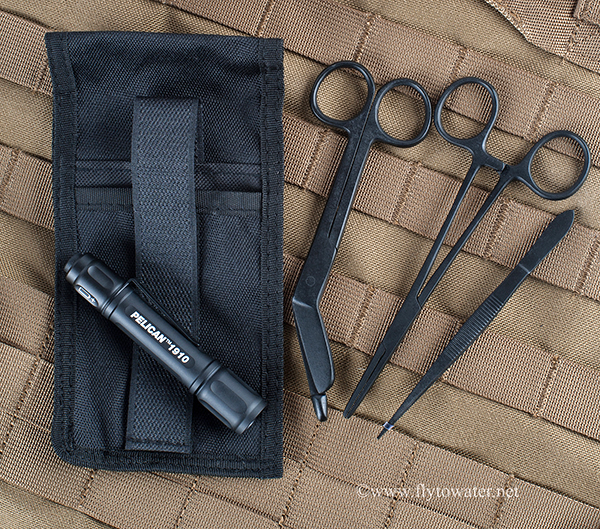
Second: An EMT Toolkit consisting of bandage scissors, forceps, hemostat, and pen light. Amazon offers a nice setup complete with all of the above in a compact holster for $17. You get a big pair of quality 5.5" shears with this package, but as they are a little bulky I use those in the larger first-aid pack kept in my vehicle. The included penlight works although it's too cheaply made to be reliable (as you would expect for this price, as a quality aluminum penlight costs around $20 by itself). I replace the light with a Pelican 1910 that runs on a single AAA battery.

Compact EMT Toolkit

All of what I have listed fits inside the ITS Trauma Kit Pouch except the tourniquet, which I affix using a ITS EDC Slimline Pouch.  The entire kit is compact and can easily be attached to or tucked inside your favorite pack or boat bag. If you aren't already in the habit of including first-aid basics in your off-grid essentials, please give it some serious thought. Thanks for reading and have a safe and successful Fall season.

Imminent Threat Solutions EDC Slimline Pouch

Monday, September 8, 2014

Reach for the Sky

This is a young deer but obviously there are some genetics at work as his headgear is violating significant vertical airspace. I'd love to be able to see this buck in 2 more years.

Mule Deer Buck

Monday, September 1, 2014

Vortex Optics Razor HD 10x42 Binocular Review

It's often correctly said that buying expensive optics is the cheapest way to go. The reason, of course, is that entry-level merchandise will produce a noticeably inferior image and potentially severe cases of ODD (Optics Deficit Disorder) . Symptoms of ODD often include doubt, self-loathing, buyer's remorse, and could even progress to the borrowing of a friend's equipment. If you use optics frequently for any pursuit, ODD can be avoided with the purchase of a high quality product (money spent on entry-level glass will turn out to be more regrettable than a case of the crusted, Norwegian scabies).

The question, such as it were, always seems to lie in that "how good is good enough" area. Ultimately, I've never heard anyone say, "Man, I really overspent on these binoculars and wish I had decided to cheap out." Now, I have heard similar assertions emanating from the spouses of optics owners. Normally these comments take on a harsh, grating tone that brings to mind a lack of overall credibility. Since such remarks are never in the first-person (i.e. "The spotting scope John bought last month nearly caused us to default on our mortgage!") they must be considered hearsay and disqualified as serious opinions.

It's a given that brands like Swarovski, Leica, and Zeiss produce World-class products for which they exact premium prices roughly equivalent to the cost of raising a child to the age of eighteen. Sportsmen refer to this sum as "well worth it" while their spousal units may employ the term "asinine" (see "well worth it").
I don't know about everyone else, but I've always tried to find a sweet spot in terms of value. As with everything, you have the law of diminishing returns in the world of optics. If I can find a product that delivers extremely high quality without an exorbitant price, it will grab my attention.

Enter Vortex Optics. Around the beginning of 2014 I acquired a pair of Razor HD 10x42 binoculars and was quite frankly astonished at the image quality they produced. I was familiar with Vortex in the rifle scope arena, but for some reason had not been paying close attention to their spotting scope and binocular offerings. As I used the Razors more and more, my feeling was they were either on par with the Big 3 or ceded precious little under the conditions I typically glass.

Blog Size Vortex Razor HD 10x42

Now, these are not inexpensive optics with a current street price of $1,199 until you consider the competition:
  • Swarovski EL 10x42: $2,319
  • Swarovski SLC HD 10x42: $1,619
  • Leica Ultravid 10x42: $2,299
  • Zeiss Victory 10x42: $2,299
I've been using the Razors all Spring and Summer, and have been comparing them most commonly with the Zeiss Victory 10x42. It's difficult to tell if one pair is markedly better than the other. The Vortex binos offer a rubber-armored magnesium chassis, argon purged tubes, extra-low dispersion HD lens elements, O-ring seals, hydrophobic coatings to repel moisture, and an unconditional lifetime warranty. In other words, all the features of optics costing $1,000+ more. I've also appreciated the eye cup mechanism with locking diopter adjustment.

The Razor HDs are simply a top shelf offering where every feature feels solid and professional grade. The focus adjustment moves smoothly with great precision, the hinge feels strong and sure, and the image is crisp with outstanding color fidelity.

If you're in the market for an 8x42 or 10x42 binocular, you owe it to yourself to check out the Vortex Razor HD.

Vortex Optics Razor HD 10x42 Vertical

Friday, March 14, 2014

Sage Evoke Fly Reel

Today, March 14th, is π (Pi) Day.  As we all know, π is an irrational and transcendental number which begins with 3.14159 and continues indefinitely without pattern or repetition.  To date, π has been calculated out to more than one trillion digits beyond the decimal point.

One might inquire as to how this relates in any way to fly fishing.  The answer is simple:  Fly reels tend to behave scientifically much like the post-decimal digits of π - increasing within the angler's collection potentially into the trillions without any particular buying pattern becoming discernible by the fisher person's significant other.

Much as π is no one's fault, the irrational and transcendental nature of fly reel multiplication is simply a mathematical principal for which blame cannot be assigned.

Why, then, might an angler who's cumulative mass of reels might be described by some as "infinite" look to acquire still more reels?

It's because they keep getting better.  Enter the Sage Evoke:

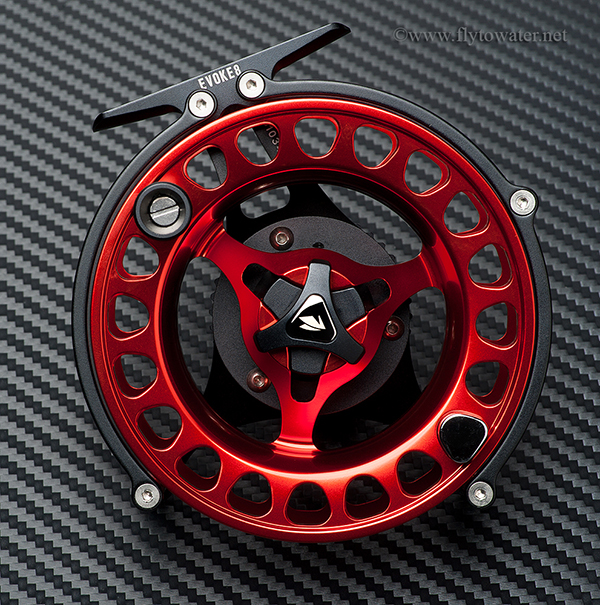
Blog Size Sage Evoke Front

For years I have been a huge fan of the 6000 series for reasons I've outlined in previous reviews.  The reliable, fully-sealed and numbered drag system coupled with the ingenious spool release just makes these fish brakes easy to use under any conditions.

The Evoke takes these features and improves upon them.

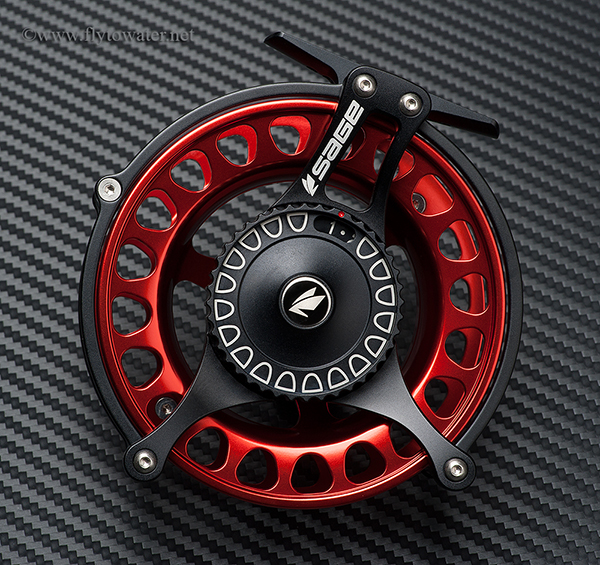
Blog Size Sage Evoke Rear

What has always been a great drag knob is now better.  The numbers are now visible through a recessed window, which makes it so they do not rub directly on boat hulls or equipment (potentially fading over time). Tension is ideal and the settings stay readily in place.

Sage has used an open frame design to expose the bottom of the spool and allow for superior palm control under load.  This is a very useful feature for any of the fast movers.

Aesthetically it's a great-looking piece of hardware and offered in 3 finishes.  Pictured is the Stealth/Blaze combination.

Brought forward is the spool release mechanism that really is the easiest all-purpose solution in the industry. Nothing else I have used allows for detachment with essentially a quarter-turn of the release, yet is also highly resistant to unintentional removal.

Are there any shortcomings?  If you need the ability to change retrieve direction, the Evoke may not be for you.  The frame opening for palming the spool is specific to right or left-handed retrieve.  I would like to see the Evoke offered in a 6-weight size but its obvious target market is stuff that pulls harder than your typical freshwater fare.

As your own fly reel collection adheres to the immutable laws of mathematics and begins to be describable only by scientific notation - make sure an Evoke is among the early additions.

Thursday, September 26, 2013

Of Tigers and Brookies

I figured it was about time to display some fish porn around here.

The more I visit central Utah, the more it feels like I should spend more time there.  Something about the crustacean-rich waters of the region invariably produces fish with incredible markings and coloration.

Tiger Trout Toned

My brother and I enjoyed a great trip down South earlier in the year.  Trips of years past have been marked by various unusual happenings such as close quarters combat with a fully-primed skunk in the confines of a wall tent .  This season, however, the only noteworthy events involved catching and releasing obscene numbers of beautiful trout.

A Brookie in the Hand...

A few of the desert stillwaters I fish offer vistas about as attractive as Conan O'Brien wearing a pair of jeggings.  Not so in the alpine country of the Beehive State.

Cody - Casting at 10,000 Feet

The full-size version of the above image shows more detail than my blog format allows.  You can click HERE for the larger size.

Cody Touches Fins

Here Cody shows a very typical fish for the area with rich colors and jewel-like markings.

Tiger trout are increasingly common in Utah's waters, but just like other species they seem to manifest more extreme patterns and buttery yellows than in other locations.

Dripping Tiger

All of these images and a few more can be seen in higher resolution in my HIGH COUNTRY FLICKR SET.  Trips with Cody are invariably entertaining in and of themselves, but it was great to touch some colorful fins, take in some thin air, and visit a few new lakes.