Showing posts with label Telephoto. Show all posts

Friday, April 15, 2011

Telephoto Fishing - The Trilogy

Speculation has been running wild among as many as 7 Fly to Water readers as to whether or not the wildly successful Telephoto Fishing series would bloat into a gratuitous trilogy.

By taking decisive action, I hope to avoid the possibility of this extreme tension spilling over into the weekend.

Part III - SIMPLIFICATION

Fly fishing photography, especially when it comes to the fish themselves, often involves unpredictable action sequences. Separating yourself from the fray and shooting at longer focal lengths makes it easier to concentrate on one aspect of the scene unfolding dynamically before your eyes.

Wide angle lenses have the capability to include so much in the frame, that a clear focal point and strong composition often become the casualties of hurried decision making.

Longer focal lengths limit field of view, and can therefore be an aid to simple, strong compositions. There were plenty of additional elements involved in the scene below: Angler, shoreline, fly rod, horizon, sky, clouds...each could have been included with a different lens choice. Going telephoto allowed me to easily exclude them all. I wanted to capture the final moment of the fight, with no distractions. Fish, net, water - the only 3 objects in the frame.


Unwilling

Picking one aspect of the proceedings to focus on is great practice for capturing action with wider lenses. Even though you can see more at wide angles, achieving a compelling image is still about anchoring the photo in an element that draws attention. Mentally narrowing your focus is a skill that can be developed by physically limiting field of view through telephoto optics.

The point of this little 3-part diddy is that the end is really about the beginning. Rather than picking the day's kit based on portability and convenience - choose instead to decide what you hope to accomplish. When simplicity of composition is the goal - complicate your packing arrangements and lug the long lens.

Monday, April 11, 2011

Telephoto Fishing Part Deux

OK, so you've mastered how to isolate your subject with the telephoto lens and create a nice, creamy background which focuses attention right where you want it.

Now we can move on to the second installment in our multi-part series entitled:

Part II - COMPRESSION

Photographers have the ability to distort perspective within the frame. Making focal length choices is not arbitrary, but has a very important impact on how the end result is presented to the viewer.

The perceived distances between the foreground, subject, and background are elements that can and should be consciously controlled.

Compression is the term for making distances appear shorter than they are in real life. Women have been doing this for eons even before photography was invented, but for our purposes we will discuss only the relative distances within an image. Long focal lengths are the visual equivalent of a trash compactor - effectively squeezing foreground, subject, and background elements together.

The sage brush behind well-known whitefish guide Casey Birkholz (below) was about 35 feet to the rear. Using a pontoon boat I created some distance and shot at 200mm, compressing the photo and making the background appear much closer.

CaseySepia

Even though almost half the frame in this shot is background, I did not want the viewer's eye to be drawn deeper into the image and beyond the subject. Use of compression made the distances appear artificially short, resulting in a more controlled portrait.

Perspective is a vital arrow in the quiver. Zoom lenses allow for a certain amount of laziness, because the photographer can stay in one place while zooming in or out to fill the frame. Doing so is a beginner's mistake! Distances and focal lengths CHANGE the resulting image dramatically. Make your focal length and compositional choices first, then move your body to accommodate the vision.

Ask not what your zoom can do for you, but what you can do with your zoom.

Thursday, April 7, 2011

Telephoto Fishing - Part I

Rod, reel, line, vest, chest/hip/backpack, leaders, tippets, fly boxes, flies, floatant, forceps, clippers, hook sharpener, leader straightener, net, waders, wading boots, wading belt, wading jacket, strike indicators, hip flask...

These are just a few of the things the average fly angler will festoon themselves with while out enjoying a day on the water. In order to avoid rolling around a humongous gear ball with our legs, like a dung beetle only on a much larger scale, fishermen often tend to economize in the camera department. Telephoto lenses taking up the same amount of space as a foot-long hoagie sandwich tend to get left at home.

I usually subscribe to this less-is-more approach myself. The telephoto lens (generally defined as a focal length greater than 100mm) does have a number of distinct advantages for fishing imagery.

Why sacrifice your 12" Meatball Marinara in favor of a tele? Backing away from the subject and shooting at longer focal lengths has some advantages. The key is to understand and visualize the types of images you hope to capture in advance, making it easier to pick the right tool for the job.

Part I - Bokeh, or Out of Focus Backgrounds

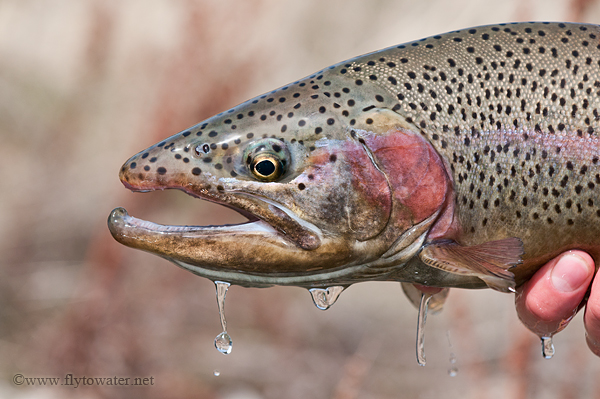
Isolation draws attention to the main subject of a photograph, which can be accomplished by rendering backgrounds that are smooth, soft, and not distracting to the viewer. One easy method to accomplish this is to simply back off, and shoot at 200mm or 300mm. Leave some distance between the subject and the background, and the result is great bokeh.


Dripping

This example was taken at f/5.6 and 200mm, allowing the trout and the water droplets to be the obvious center of attention.

Just because you can get close, doesn't always mean you should. Go long for this type of result.