Showing posts with label Composition. Show all posts

Saturday, October 15, 2011

Kid Stuff

If you are more perceptive than I am, you might have noticed that there is occasional fly fishing content on this blog.  Such an observation might lead a person (not that I am referring to any type of spousal unit here) to the mistaken belief that all I do is fish.  Nothing could be further from the truth.  I only mostly fish.

Take this morning, for example.  I had the mandate opportunity to accompany my niece to her last soccer game of the season.  At six years old she is considerably better at fĂștbol than Uncle Fly to Water, so I brought along the camera to get a couple shots of her in action.

Whether it's team sports, fly fishing, or portraiture there are two basic fundamentals of composition that are helpful to keep in mind when photographing kids.

The first seems obvious but I'm surprised how often it's overlooked.  Children are classified scientifically as short people, or stubby sapiens if you want to get technical.  Adults taking pictures of kids usually don't bother to kneel or sit on the ground so as to shoot from eye level.  Dropping down will often result in the heartbreak of grass-stained jeans, but a level perspective gives the subject more prominence.

Secondly, as with most portraits, it's important to align the child's eyes with the upper third of the frame.  This is a fundamental of the Rule of Thirds that helps the viewer connect more intuitively to the subject.
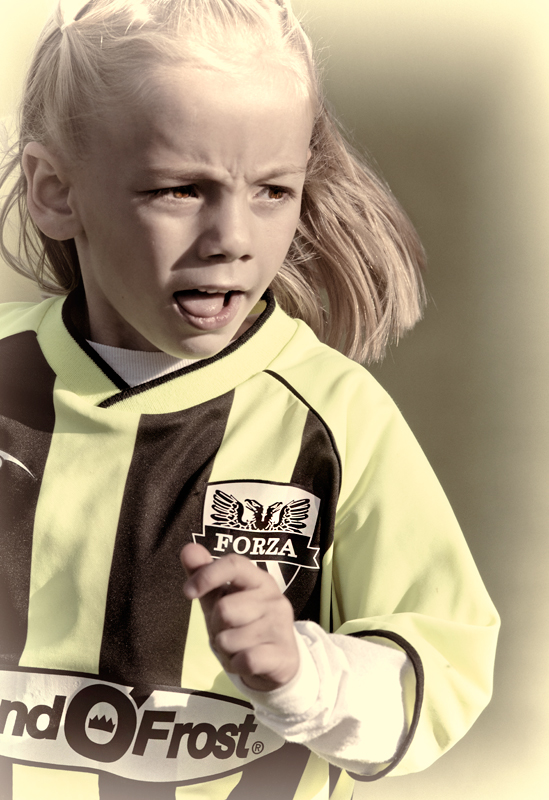
Sarah - Team Lemonheads

This photo was taken at 8x optical magnification and f/5.6, which is well within the range of nearly all point & shoot cameras.  The reasons I like this image are purely compositional and result from several concious choices:
  • Positioning the camera at eye level
  • Including story-telling elements (expression, jersey, implied motion)
  • Excluding distracting elements (other players, chairs along the sideline, goal posts, etc.)
  • Alignment of the eyes along the upper third of the image (Rule of Thirds)
A repeatable recipe for fun kid shots is to get low, and simplify the image by leaving out anything that doesn't need to be there.

I really did have a great time at the game this morning and it was my privilege to be cheering for the Lemon Heads (as they call themselves).  For the most part I hardly thought about my Sage One 796-4 fly rod that needs to get bent very, very soon by some slab-like salmonids.

Saturday, August 20, 2011

Loaded for...Chipmunk

On a recent hike into the backcountry looking to photograph elk, I decided to carry the Boomstick - a Nikon 400mm f/2.8 AF-S VR lens. When I say "carry" I don't mean in a backpack or harness, I mean freehand.

With camera and grip attached, this rig weighs in around 13 pounds. I often carry this lens without a pack, and shoot it hand held. Mature bull elk in areas where hunting is prevalent are a cagey bunch, and opportunities can last only seconds.

In this case, however, I hiked over an area roughly the size of the Louisiana Purchase and didn't catch a single glimpse of elk hide.

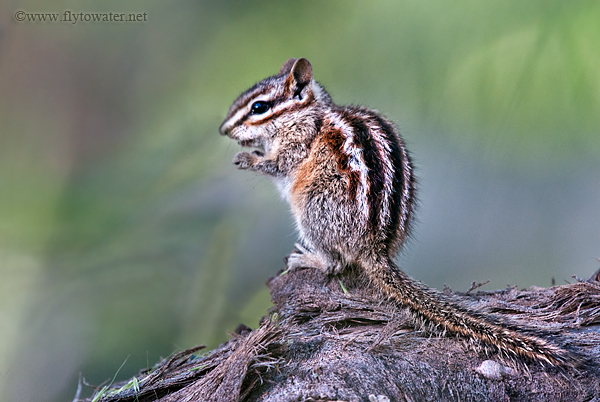
As I was making the steep descent back to the vehicle, I came across a common Least Chipmunk, neotamias minimus.

A few things jumped out at me when I spotted this little guy.
  • He was facing towards the sun, allowing for the all-important catch light to be reflected in his eye. This is a small detail that is always on my mind when photographing animals.
  • The chipmunk was positioned on a log that would give the foreground some texture, as well as a little elevation from the grasses on the forest floor.
  • Most interesting was the pattern of pine needles and leaves in the foliage beyond the perch. I immediately knew this would make for a soft, dappled, pleasing background.
When looking to capture an image of a relatively common subject, consider ways you can make the rest of the frame uncommon. Foreground, background, texture, and details like catch light are great ways create engagement with the viewer.

The final step involved compositional fundamentals.
  • It is key in wildlife portraits to shoot at eye level. I had to get very close to the ground to accomplish this, but it's important because downward angles in photography weaken the subject's presence in the image.
  • The chipmunk's eye is located 1/3 of the frame from the top edge, which is a foundational element of the Rule of Thirds as it applies to portraits.
  • Lastly, I chose a position that allowed the chipmunk's tail to enter at the corner, creating a natural leading line for the eye to easily follow into the photo.
When getting outfoxed by the day's primary objective - improvise and look elsewhere. The practice pays off when the main event suddenly shows up, and all these fundamentals need to be more instinctive and less deliberate.

Snacking Chipmunk

Nikon D300
Nikon 400mm f/2.8 AF-S VR (hand held) - f/5.6, 1/250
LensCoat Camoflauge
Equivalent Optical Magnification: 8x
Sitka Gear Open Country Camo
Distance to Subject: 20 feet