Showing posts with label Fly. Show all posts

Friday, March 14, 2014

Sage Evoke Fly Reel

Today, March 14th, is π (Pi) Day.  As we all know, π is an irrational and transcendental number which begins with 3.14159 and continues indefinitely without pattern or repetition.  To date, π has been calculated out to more than one trillion digits beyond the decimal point.

One might inquire as to how this relates in any way to fly fishing.  The answer is simple:  Fly reels tend to behave scientifically much like the post-decimal digits of π - increasing within the angler's collection potentially into the trillions without any particular buying pattern becoming discernible by the fisher person's significant other.

Much as π is no one's fault, the irrational and transcendental nature of fly reel multiplication is simply a mathematical principal for which blame cannot be assigned.

Why, then, might an angler who's cumulative mass of reels might be described by some as "infinite" look to acquire still more reels?

It's because they keep getting better.  Enter the Sage Evoke:

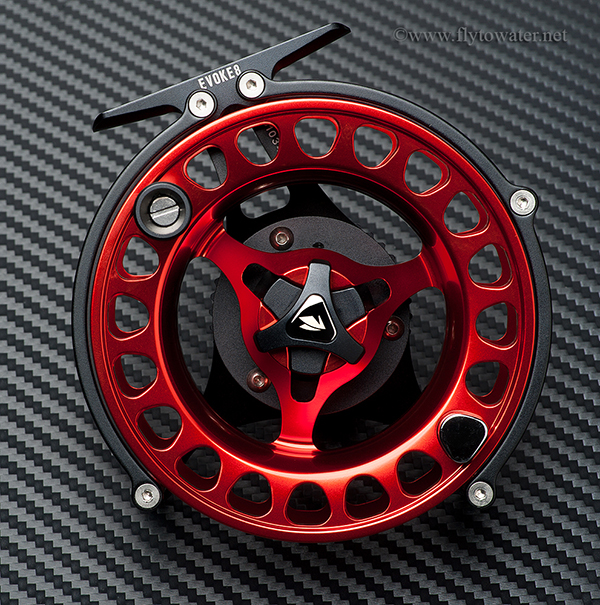
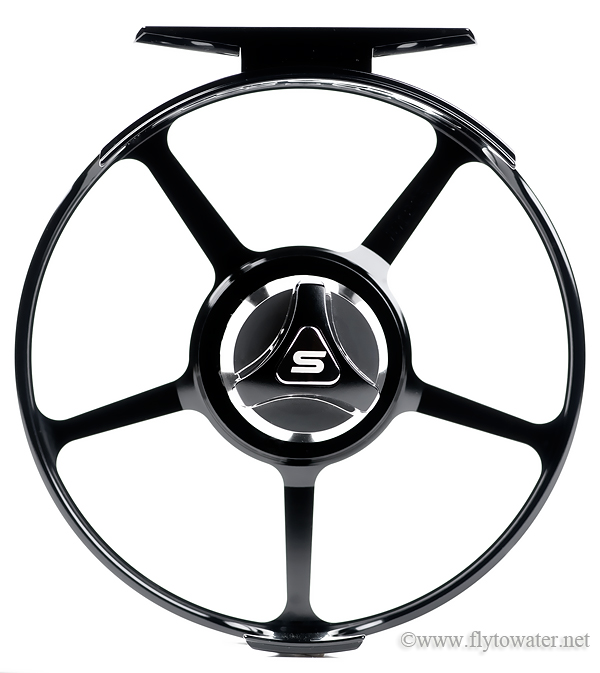
Blog Size Sage Evoke Front

For years I have been a huge fan of the 6000 series for reasons I've outlined in previous reviews.  The reliable, fully-sealed and numbered drag system coupled with the ingenious spool release just makes these fish brakes easy to use under any conditions.

The Evoke takes these features and improves upon them.

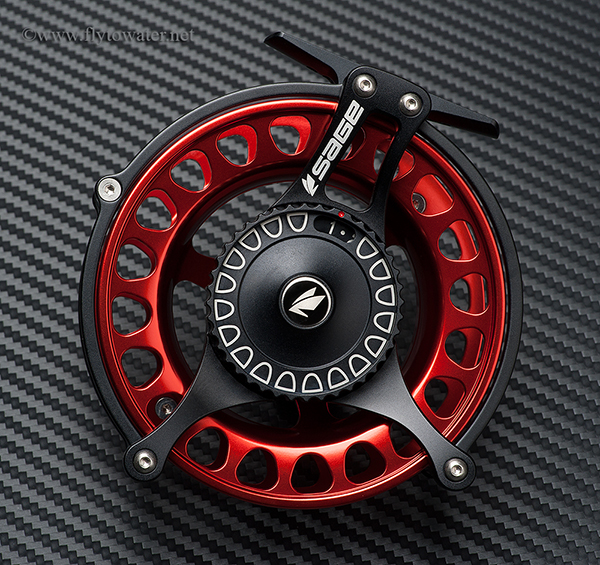
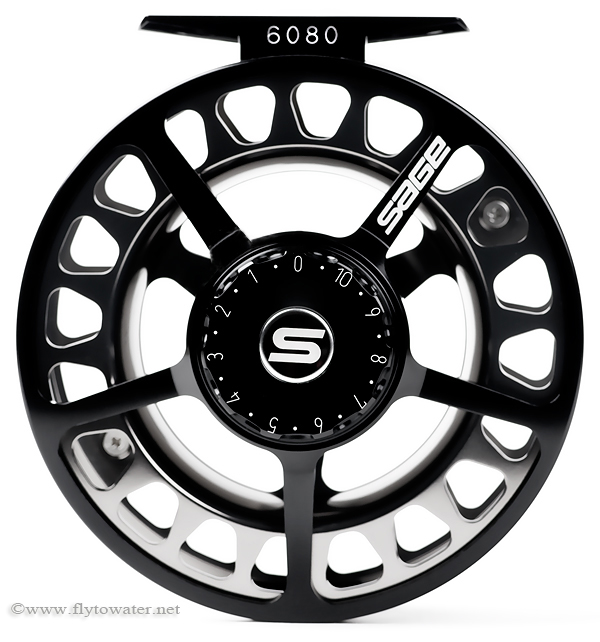
Blog Size Sage Evoke Rear

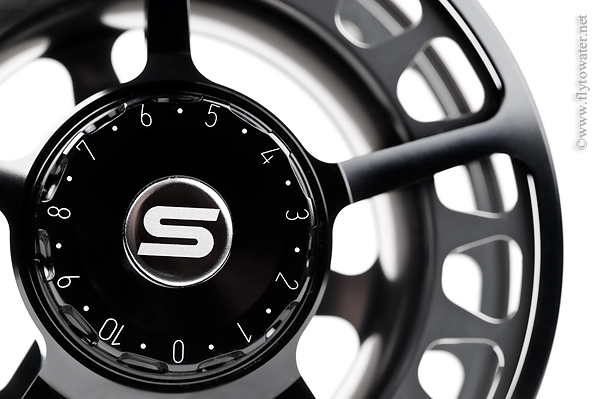
What has always been a great drag knob is now better.  The numbers are now visible through a recessed window, which makes it so they do not rub directly on boat hulls or equipment (potentially fading over time). Tension is ideal and the settings stay readily in place.

Sage has used an open frame design to expose the bottom of the spool and allow for superior palm control under load.  This is a very useful feature for any of the fast movers.

Aesthetically it's a great-looking piece of hardware and offered in 3 finishes.  Pictured is the Stealth/Blaze combination.

Brought forward is the spool release mechanism that really is the easiest all-purpose solution in the industry. Nothing else I have used allows for detachment with essentially a quarter-turn of the release, yet is also highly resistant to unintentional removal.

Are there any shortcomings?  If you need the ability to change retrieve direction, the Evoke may not be for you.  The frame opening for palming the spool is specific to right or left-handed retrieve.  I would like to see the Evoke offered in a 6-weight size but its obvious target market is stuff that pulls harder than your typical freshwater fare.

As your own fly reel collection adheres to the immutable laws of mathematics and begins to be describable only by scientific notation - make sure an Evoke is among the early additions.

Sunday, June 9, 2013

Sage 6060 Stealth Reel

A few friends of mine claim that I own so many fly reels, that putting them all in the same place could potentially form a gravitational singularity that would eventually consume the Earth.

While I have serious doubts as to this possibility, I choose not to tempt fate and disperse my reels evenly across the geography I have available.

The point is that I'm no stranger to fly fishing hardware, and have owned or used just about everything on the general market at one time or another.  Excellent offerings exist in all categories from a variety of manufacturers.

Still, once in a while something special comes along and in my opinion Sage has just raised the bar in the heavily competitive 6/7 weight arena where, incidentally, 80% of my angling takes place.

Some time ago I wrote a review of the larger 6000-series bodies and found them to be outstanding reels for saltwater or anything requiring a dependable brake and a stick larger than an 8-weight.  At that time I really wished (and discussed in my commentary) that Sage would improve the selection of finishes available to become more competitive aesthetically.  Saltwater is only something I get the occasional chance to enjoy, so also on my wishlist was a 6-weight version of the flagship reel.

Enter 2013, and Sage now offers the 6060 in several new finishes including Stealth, Azure, and Storm for lighter tackle.  It's a dinger of a home run.

Just about every reel I've ever used has some kind of quirk which, in daily use, winds up causing a galloping neurospasm.  Maybe there are no reference markings on the drag knob, or the tension thereof is insufficient and results in unintentional adjustments.  I change spools a lot, especially when fishing stillwater, and many models are flawed in various ways here too.  O-ring seals become very difficult to remove in the cold, some have small parts that may come loose and can potentially be lost, and others utilize spool releases that are tiny or difficult to access with gloves.  I happen to cast and reel with my right hand, and changing retrieve direction can be a hassle with a number of current designs (a few are even best left to the factory or dealer).

The 6000-series addresses all of these issues...perfectly.

Releasing the spool, as anyone who has used this lineup knows, is a true industry innovation.  It's easy, can be done with gloves, works regardless of temperature, and is exceedingly unlikely to happen inadvertently.

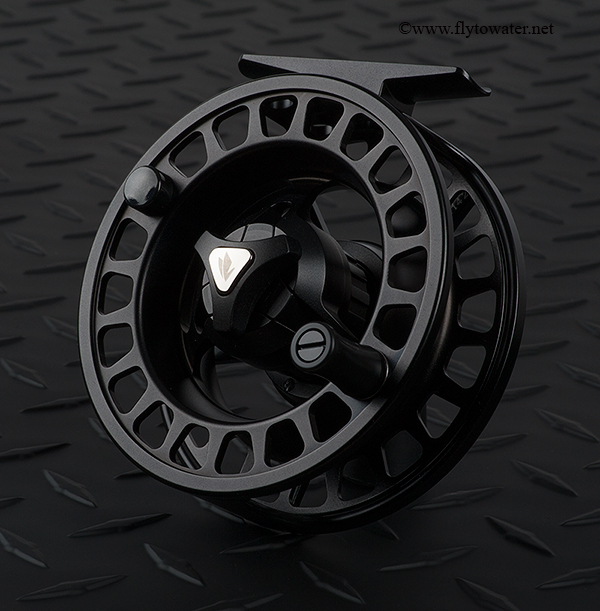
Blog Size - Sage 6060 Stealth - Front

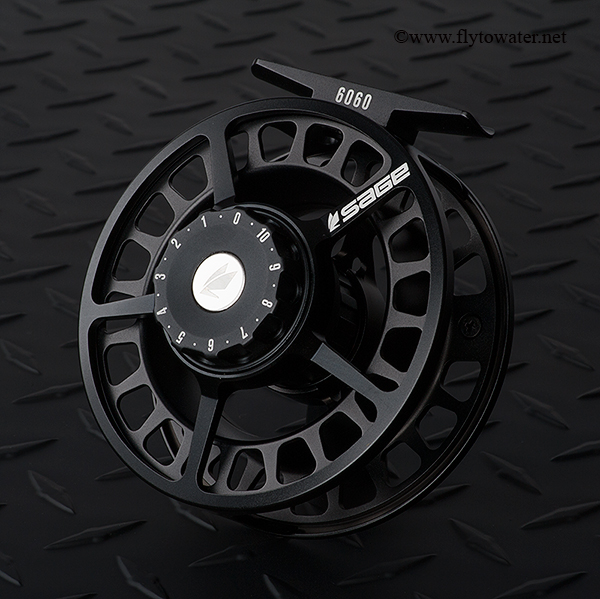
The drag knob has an ideal resistance, as well as being incremented with readily visible numbers.  As a big plus, it also traverses the full range of adjustment in 1 revolution.  Retrieve can be easily changed from left to right hand using the supplied wrench.

Sage offers a utilitarian design in terms of weight savings and frame strength, but it's visually compelling as well. In the new Stealth finish, the whole package is unbridled bad-assery.

Blog Size - Sage 6060 Stealth - Rear

I really have to hand it to Sage.  The 6060 is the first reel in the 6-weight class with which I can find no quirks. Over the past several years I've been fishing a variety of hardware from companies like Nautilus, Lamson, Galvan, and Sage.  All are very good.  Until now, however, I haven't used anything that manages to function so seamlessly and glitch-free in all the key areas.

If you are considering this reel, just pull the trigger.  It's a shot across everyone's bow.

Fly to Water Rating:

 - Drag: Fully sealed, numbered, with ideal tension.  Best spool release in the industry.
★ - Price: On par with the competition, less money than many flagship offerings.
★ - Weight: 6 2/5oz - not the lightest in the segment but balances nicely on 6/7wt rods
★ - Design: Looks wicked, functions seamlessly in all conditions and with gloves, nice finishes.

A five star sweep.

Monday, March 5, 2012

Soft Water

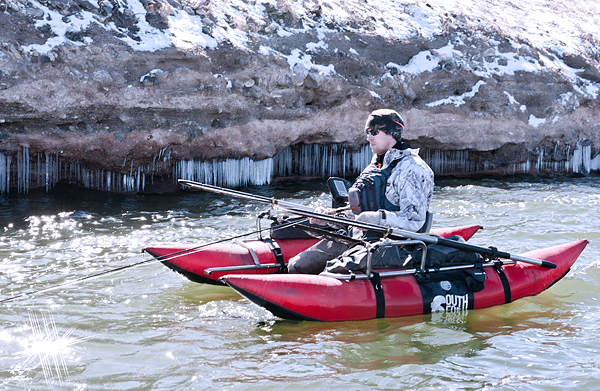
We interrupt our regularly scheduled programming, because it's frankly still hard to believe that for the past several weeks I have been fly fishing mid-elevation stillwaters in Utah.  During February.  No ice holes required.  As in casting a fly line and having its entirety land on liquid where there would normally be 14 inches of solid ice right now.

The Hell you say?  Well, in all past years of my lifetime you would be entirely correct in calling BS - but not THIS year.  Hungry trout have been tearing the chenille off my flies right down to the bare hook because no one has told them there's another month of Winter supposedly going on right now.

Icicles

It has been butt-numbing cold at times, but this is OPEN WATER we are talking about.  The cure to cabin fever. 

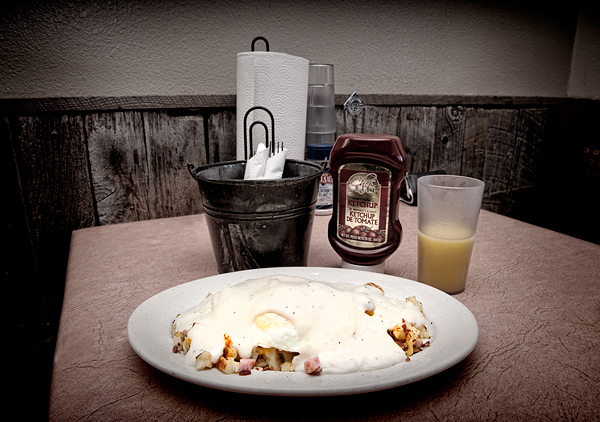
Not only that but in the town of Circleville a guy named Mike, proprietor of Butch Cassidy's Hideout, makes something called a Hash Stack.  It's a conglomeration of hash brown potatoes, ham, sausage, bacon, and 2 eggs smothered in country gravy.  One eats this breakfast, and then fishes all day with  no additional nutrient requirements.

The Hash Stack

Early in the season I am giddy to fish and don't spend much time behind the lens. While rivers are certainly available all Winter long, stillwater trout on the fly at 6,500 feet in February... it's just unheard of.

Here's to places of extremes.  See you on the water.

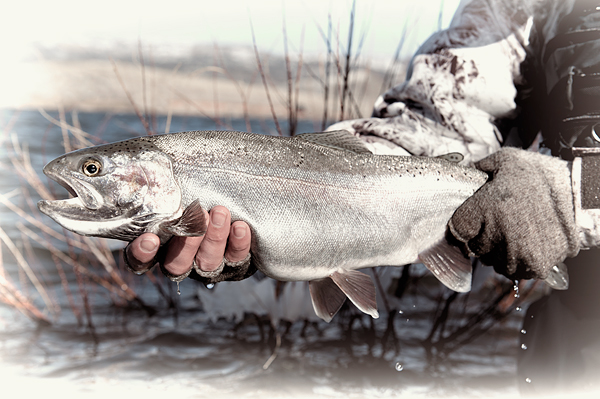
Hen Rainbow at Ice Off

Thursday, February 23, 2012

Apocalyptic Fishing II

Alert!  303 days remain until the end of the Mayan calendar on December 21st.  Yes, some experts do believe it's actually December 23rd, in which case we still have a very comfortable 305 days left.

It is now time for the second installment of Apocalypse Gear - the feature that helps you, the angler, prepare for zombies.  Today's episode is a double feature, and starts out with rod selection.

You'll want to travel light with the undead roaming freely around your favorite waters, so it may make sense to select just one fly rod that can do it all.  My pick is the aptly named Sage One, in a 796-4.  This stick will handle everything - trout, steelhead, muskie, bass, salmon - and it won't shun light saltwater duty either.  As an added bonus, the rod tube is solid enough to use as a bludgeon and will never give your position away with unwanted reflections due to the matte black coating.

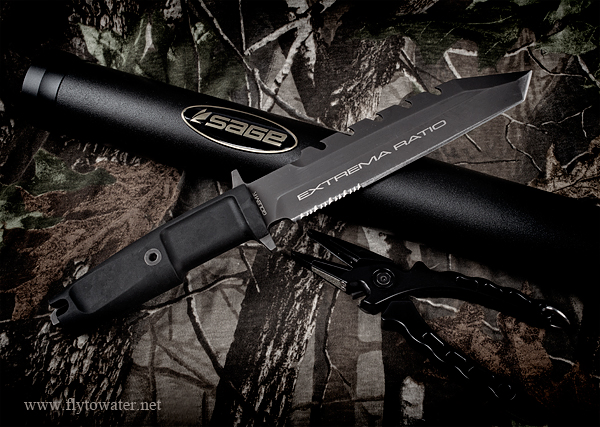
Extrema Ratio 58 HRC Golem


It's a good idea, even pre-doomsday, to have access to a few handy pieces of cutlery when in the outdoors.  As survival knives go, I haven't found anything better than the Extrema Ratio Golem for taking into the back country.  The blade is 58 HRC stainless cobalt steel, an alloy that is often used for cutting other steel.  It stands up very well to chopping and prying, where knives that focus strictly on sharp edges often fall short.  The Golem has a tanto point, and the blade is partially serrated making tasks like rope cutting a snap.  It also offers a robust dorsal saw that, while definitely requiring some effort, cuts very well.  Even the lanyard loop is a solid piece of hardware than can be used for striking, glass breaking, etc.

Parry...Parry...Thrust...Cast  - Good!

Friday, February 17, 2012

Apocalyptic Fishing

As Fly to Water has alertly reported in several recent posts, the Mayan calendar ends this year.  The most likely cause of this situation is that the company building the calendar misrepresented it's financial statements, resulting in dramatic stock price deterioration and subsequent layoffs.  All of the Mayan executives, or chiefs, retired to the Caymans.  Calendar-building laborers were then faced with a large spike in temple foreclosures and ultimately relocated, leaving all the post-2012 work unfinished.

Alternatively, some kind of zombie apocalypse is going to take place this December.  The dead rising from the grave, human sacrifice, dogs and cats living together...MASS HYSTERIA.

While the media has buried its teeth in this topic like a gila monster on ankle flesh, the most important consideration has been totally ignored: How are we going to fly fish when the end of days arrives?

As a public service, I hereby offer up a series of posts containing gear ideas and recommendations for apocalyptic fishing.

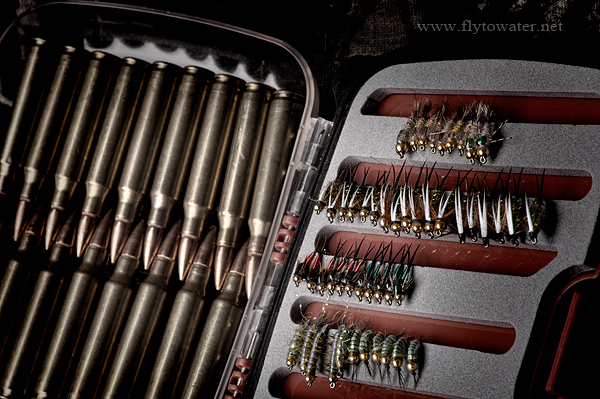
Apocalyptic Fishing - 5.56 Nato Edition

First and foremost - at the moment of truth you don't want the heartbreak of reaching for your ammo and pulling out your flies instead.  My world's first concept combines a waterproof fly box with 5.56 Nato assault rifle ammunition.  One swift grab into the sling pack, and you've got access to Copper Johns and copper-jacketed .223 hardball.

Get some!

Friday, January 13, 2012

Getting Started in Photography - Part One

Here we are at the beginning of 2012, less than 12 months away from the END OF THE WORLD on December 21st according to the Mesoamerican Long Count Calendar.  As a major socioeconomic force, Fly to Water will now respond to these most weighty of matters by discussing: How I got started in photography.

In the Fall of 2005 I was contemplating a great truth: There were people who could take a quality photograph, and I was NOT one of them.  At the time my definition of "quality" was somewhat limited, but I knew that certain images were engaging, held my attention, and struck me as art.  By contrast my work was as attractive as an uncorked bung hole.

Of course I had the option of going out and buying a nicer camera than the Nikon D70 I was shooting, which would make an immediate difference by doubling the file size of my schlocky snapshots.  Oddly, many people believe in the mathematical formula E = GP², where E is an expensive camera and GP is a constant called "good photos."  I call this the Kopi Luwak delusion: You'd think I was making this up, but there are actual people who profess that because coffee beans are eaten by a civet cat and shat out in the jungle, they make a phenomenal beverage.  Now the civet cat is a fine animal, and my Nikon D70 was a solid camera, but it turns out both can be sorely misused.

This leads me to my point: Dudes are out there selling palm civet dingle berries for $160/lb. 
If you're getting started in photography or looking to improve prior to December's sweet release, consider this:
  • Anyone can take great photos, regardless of what you feel your natural talent/ability level might be.
  • You will need to work at it, with the same kind of dedication that it takes to sell cat crap coffee.
Very early on I came to the realization that successful images happened because of the human elements of photography.  More importantly, I began to discover that many of the qualities generally described as "artistic" were acquirable.  There were principals, camera controls, and techniques which could allow me to get the results I wanted - if I was willing to educate myself.

Step One: Composition

We live in a 3-dimensional world, and from the youngest of ages our minds are conditioned to connect with an environment that involves depth, distance, and perspective.

I was fascinated to learn that the human mind naturally imposes 3-dimensional thinking on flat, 2-dimensional images.  It turns out that fairly straight-forward guidelines exist which help broker the connection with the viewer.

In a general sense, this is called "composition," or the way in which objects are arranged (intentionally and creatively) within the frame. There is nothing about composition that should be left to chance. Inclusion, exclusion, angle of view, position relative to the subject(s), portrait vs. landscape orientation, foreground, background, and many other considerations play an enormous part in how the viewer will interpret a 2-dimensional image.

It took some reprogramming for me to begin seeing in 2 dimensions - actively thinking about how I would use the spacial relationships in the frame to hold attention rather than create distraction.

The topic is too broad to cover in a blog post, but here is the take away: Regardless of your equipment, there is a FREE way of making your photos more engaging with simple compositional techniques that can be learned and practiced at home.  I started by reading Photographic Composition, and Brenda Tharp's excellent Creative Nature and Outdoor Photography - both available on Amazon for about $15 bucks.

Read up before 12/21/12, when it will be human sacrifice, dogs and cats living together... MASS HYSTERIA.  If this has been helpful, drop me a line.  I've got a few more pre-cataclysm thoughts brewing.

Sunday, November 13, 2011

Nothing but Net

For about the last quarter century Wachter has been cranking out hand-made fly fishing nets down in St. Paul, Texas.  About 2 years ago I was poking around online looking for a combination of features that I hadn't found locally.
  • I wanted a mid-length handle.  It needed to be longer than all the typical trout nets made to hang neatly from the back of a fishing vest, but not as long as the usual boat style.
  • My goal was to find a slightly over sized hoop without infringing on portability.
  • The bag needed to be tangle-free, hook resistant, and difficult for a fish to twist while netted.
  • An individual look rather than a sterile, manufactured appearance - but without being too expensive.
  • Made in the USA.
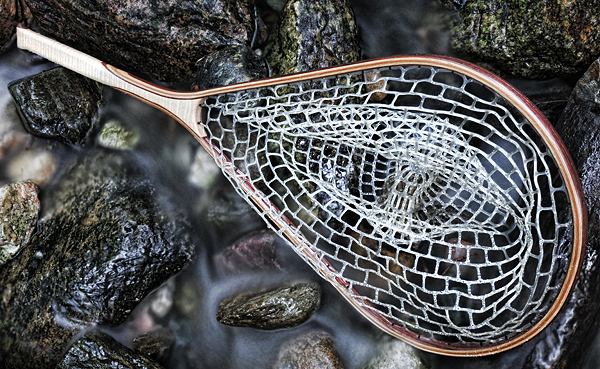
I happened upon Wachter and found a model called the Magnum Pontoon that was exactly what the doctor ordered.  On top of the fundamentals I was nosing around for, they had one in stock with a beautiful curly maple handle...

Wachter Nets - Magnum Pontoon Net

This has turned out to be my all-time favorite net.  The proportions were ideal - perfect for extra reach on the pontoon, but short enough that it easily holsters in a wading belt without getting in the way.  The PVC net bag is sufficiently rigid to avoid twisting, and it's easy on the fish.  Wachter also has a new MRB (Molded Rubber Bag) option in addition to their injection-molded PVC that's lighter and more flexible.

Actually I don't even get to fish with my Magnum Pontoon about half the time, because anglers are an unscrupulous lot who think nothing of snatching up a companion's net and darting off at speeds that risk a groin pull.

Since my initial purchase, I've since added a couple more of these beautiful nets to the gear bag.  Plenty of custom woods and options are available.

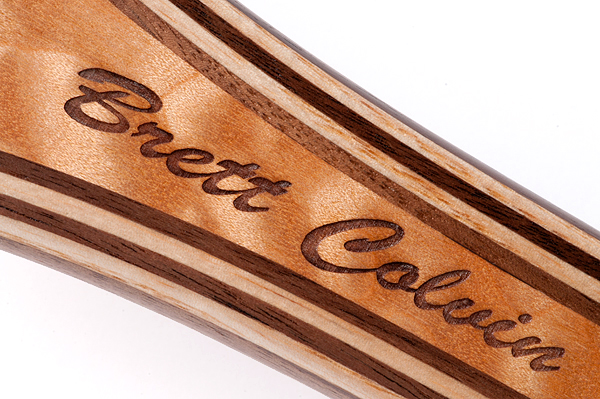
Engraving:

Wachter Nets - Custom Engraving

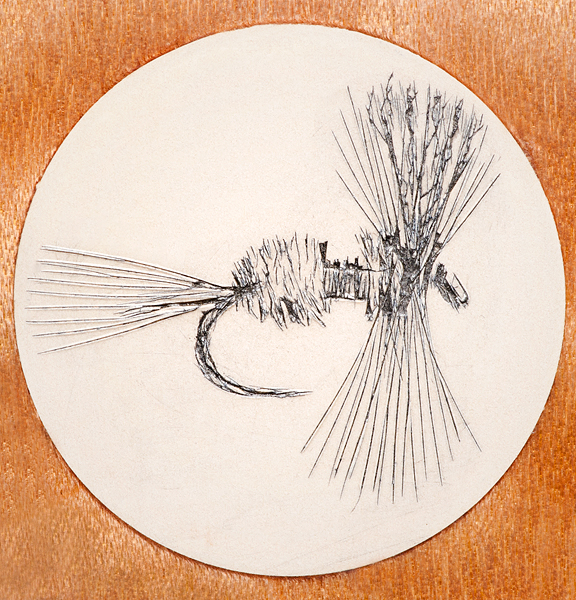
Scrimshaws:

Wachter Nets - Custom Scrimshaw

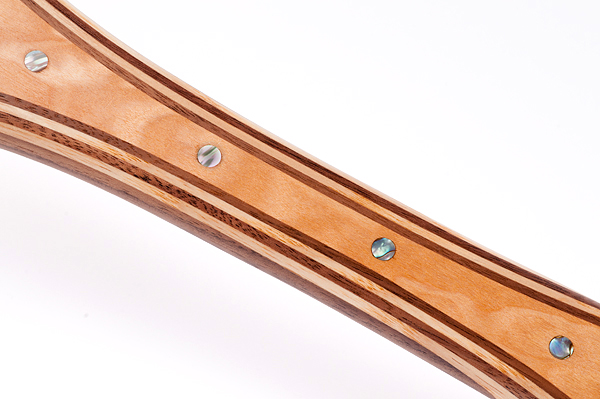
Measuring dots every 2-inches on the longer handles:

Wachter Nets - Measure Dots

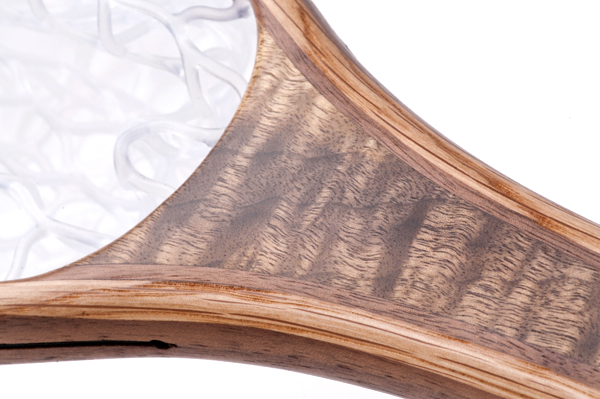
A variety of woods like this maple burl:

Wachter Nets - Brace - Myrtle Burl

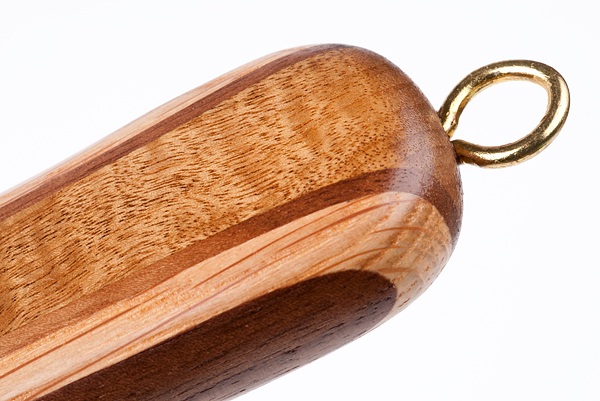
UV-protected, 6-step marine-grade finish:

Wachter Nets - Handle - Myrtle Burl

Net prices start at $60 for the Outfitter series, and both Guide and Master grades are offered.  You can order a completely custom net, or take a look at models which are available for purchase immediately here:

In Stock Wachter Nets

If you get one, choose your fishing buddies carefully.

Saturday, October 22, 2011

Sage 6080 Fly Reel

Fly to Water doesn't sell any fly fishing gear or offer commission-based links to companies that do.  When I write about equipment it's usually due either to reader inquiries or impressions I personally want to share.

Sites like MidCurrent do a fantastic job of emerging product coverage, including videos and a plethora of initial thoughts.

My reviews are based on long-term use as an angler.  In the case of the Sage 6080, I've been using the reel for 2 years.  Some of the species that have tugged on the drag include tarpon, snook, jack, tiger musky, bonefish, largemouth bass, and trout.  Living with a piece of gear for this amount of time tends to shed light on factors that might not be as readily apparent once the newness wears off.

What stands out about the 6000 series?  First and foremost is the spool release mechanism - there is nothing on the market quite like what Sage has accomplished here.  Depending on what kind of fishing you do, it may or may not be necessary to frequently change spools.  In my case, I change spools a lot.  During much of the year, the switcheroo is happening when it's cold enough to freeze the balls off a brass monkey.  Certain reel designs can range from slightly inconvenient to REQUIRING the use of galloping profanity in such conditions.  Not so with the 6000-series. Nothing could be easier under any scenario, with or without gloves, than the effortless locking system of Sage's flagship reel.
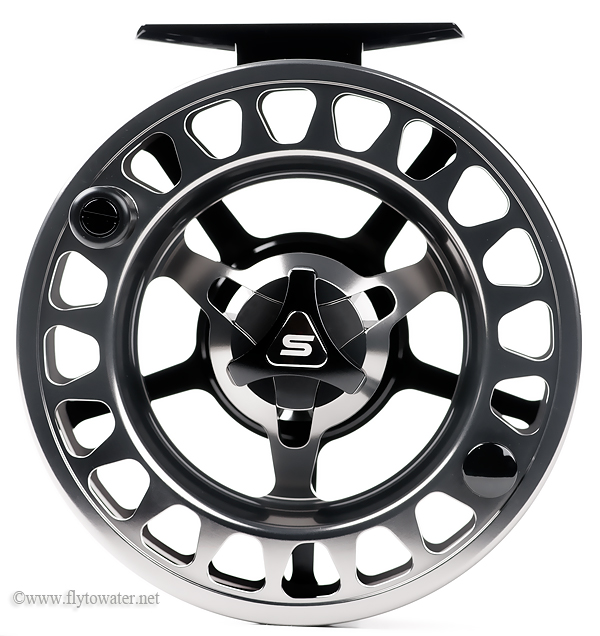
Sage 6080 Front View


Originally I suspected the system was so simple to use that over time it might result in premature despoolization (PD), or an unwanted release.  To date this has never happened.  The alignment needs to be so visually precise to free the spool that it's highly unlikely to occur by accident.  In my opinion this is the best retention system on the reel market - the spool can be removed or replaced with a 1/3 turn of the lock.

The drag is a heavy duty affair utilizing carbon and stainless steel disks in a fully sealed cassette.  It's very strong, and dissipates heat efficiently.  Yes, it will stand up to the full range of big game you might chase with 8-12 weight rods (available models are 6080, 6010, 6012).

Where the 6000 series again stands apart is the drag knob.  The full range of motion is 1 revolution, and it's numbered.  I'm still a little baffled as to why more manufacturers don't offer some kind of drag index.  I want to mention here that well-executed drag numbering does a few things:
  • Provides a means of visually setting the resistance
  • Allows for repeatable settings to be achieved
  • Can be duplicated across multiple reels
Well, the 6080 delivers on all points.  In higher stress applications it's sometimes useful to actually test the breaking point of your leader/tippet combination.  The bigger the game, the more important it becomes to have the ability to confidently set your drag, and know that  5 = 5 every time.  You may even have multiple spools that are rigged differently, requiring discreet tension levels.

Sage 6080 Numbered Drag Knob


While certainly not laboratory quality I've used a scale accurate to 1/100 of a pound to test multiple copies of the 6080, and found the drag settings to be very repeatable.  If you are a guide/outfitter and want several clients to be using equivalent rigging, this is a highly desirable feature.  An associate of mine who regularly takes clients to Cabo for inshore species has gone exclusively with 6000-series reels based primarily on the drag system's combination of high performance and reliable/repeatable numbered settings.

Switching from left-hand to right-hand retrieve is easy and involves inverting the clutch bearing inside the cassette.  This is done with no tools and instructions are included with the reel.

The frame is light weight and rigid.  Sage does a good job of going with a minimalist design that still results in plenty of bracing.

Sage 6080 Frame

On the subject of visual impact, there is an attractive symmetry to the reel.  Five spokes out back create identically-shaped voids, and in the front there is balance between the 3-spoke spool and triangular spool release.

So what could Sage improve here?  My main suggestion would be to offer a 6060.  As someone who fishes a lot of stillwater, there are constantly 4 or 5 lines in my kit.  Swapping spools this easily is so convenient that I've been known to fish the 6080 on my 7-weight.  In a slightly smaller size, I'd prefer the 6000's design to the O-ring release system of many other reels - including Sage's own 4500 lineup.

I also feel that many anglers personalize their rig via the reel.  Rods have a tendency to look very similar from anything but a short distance away.  Distinctive/individual appearance is something many customers look for, and I'd like to see more variety in the selection of finishes.  Even a black-on-black 6000 would be welcome.

Fly to Water Rating:
★★★★★ - Drag: Numbered, 1-Rotation, Fully Sealed, Stellar Spool Release
★★★★★ - Price: On Par with the Competition in this Segment
★★★★★ - Weight: A Hatch 7+ is 8.6oz, the 6080 is 7.37oz, a Lamson Vanquish 8 is 7.30oz
★★★★☆ - Visual Design: Could Benefit from a few More Color Schemes

Get a 6000-series from your local Sage dealer, or visit the crew at Stillwater Fly Shop.  Tom and his staff offer incredible customer service, a free fly line with your 6000, and free shipping.  They also have a video review HERE.

Wednesday, May 25, 2011

On the Rocks - Rocky Maley

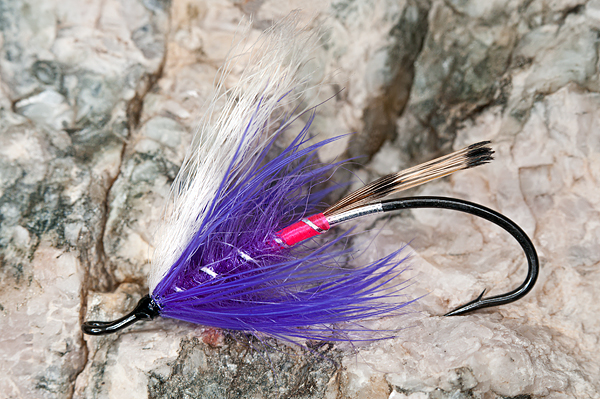
At the Wasatch Fly Tying & Fishing Expo, Rocky Maley tossed me one of his salmon flies. I thought I'd share a quick shot of this beauty because he wraps some mean mylar.
This a 3:1 supermacro, so it's three times life size in the image.

If you are interested in contacting Rocky, you can reach him at maleyqh@ortelco.net.

Rocky on the Rocks

Monday, May 9, 2011

Fishtopia

In the world of fishermen, fantasies abound. As an example, consider the following completely outlandish and unlikely scenario:

You arrive on location for a day on the water, planning to pursue the prized species of your choice. Awaiting you is a well-maintained, late model drift boat ready to embark. The on-board cooler has been filled with your food and beverage of choice.

Nothing too unusual for a guided outing so far, and no suspicions are aroused. During a non-fantasy outing, the guide then emerges from his vehicle. He is a bedraggled individual, bleary-eyed from lack of sleep the night before. He stares at you with a morose, far-away look through sleep-sodden eyes and breaks the predawn silence with a belch that wakes up every bullfrog within a 10 hectare radius. This is likely to be one of his more pleasant biological emissions as the day progresses.

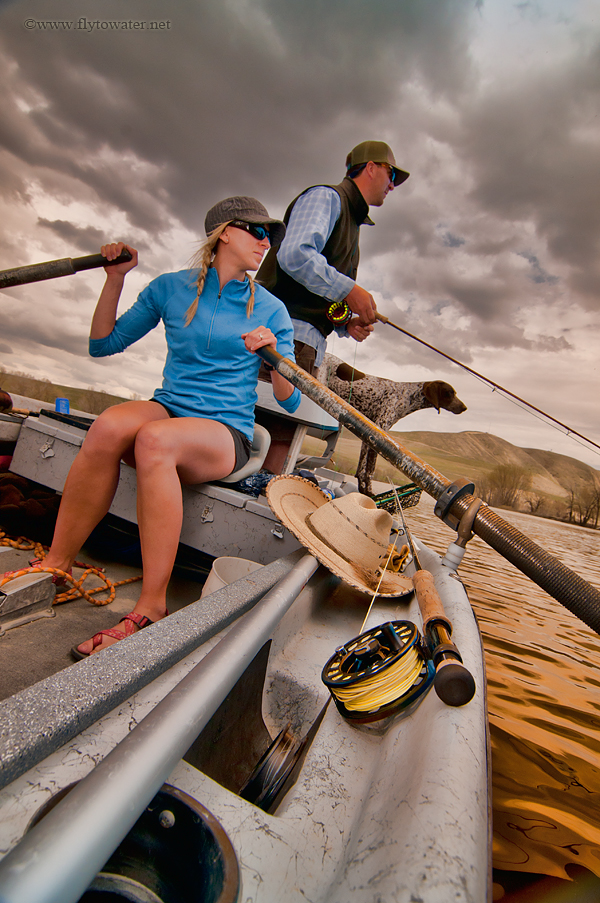
Allowing our minds to stray, let us instead imagine a slender blonde lithely exiting the guide vehicle, attired in some aesthetically pleasing shorts. Braids keep her golden locks at bay, because she is all business. Barking a few initial orders lets it be known who runs the show. While certain stereotypes attempt to crowd their way to the front of the mind about this being a man's game, quality work at the oars quickly puts all concerns soundly to rest.

The fictitious blonde proceeds to put you into the most fishy water around, pausing only to grab you an ice cold beverage the instant you begin to feel in the least bit parched.

Approaching a stretch where some technical casting is required, you festoon the branches on shore with a series of macho yet ineffectual casts. It turns out the archer fish is among the few species that will strike at a streamer a full 6 feet above the surface of the water. Your petite guide assists with fly retrieval, and then adroitly performs numerous and flawless casts in order to demonstrate proper technique. She hands the rod back to you with a snide remark, something like "Now keep this bug out of the damn cabbage!"

Sound preposterous? I would wholeheartedly agree if it wasn't for the fact that the scene described above materialized right before my eyes this weekend. Some lanky, fleece-vested type loosely associated with WorldCast Anglers claimed to have something to do with Missy's formidable skills on the sticks - but history teachers are notorious for sweeping exaggerations. If you don't believe me consider this: Following the War of 1812 (actually taking place in 1812, 1813, 1814, and 1815) came a period known as The Era of Good Feelings. It turns out that during this time, there were numerous BAD FEELINGS which were swept under the carpet, ultimately exploding into The Panic of 1819. High school history teachers have collectively refused to address this glaring issue by renaming the span from 1816-1824 "The Era of Mixed Feelings."

Missy on the Stix

Blue Lagoon

Many thanks to Missy & Casey for letting me tag along on the trip. I broke out the trusty Singh-Ray Gold & Blue filter to create the look in these images in-camera.

Friday, March 18, 2011

Open Water

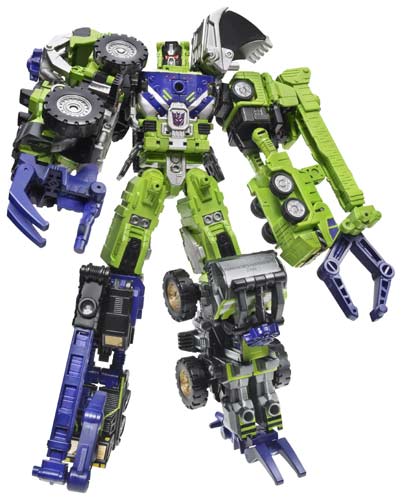
During my formative years I was a fan of Transformers. Among my all-time favorites were the Constructicons - a group of individual transformer vehicles that had the added benefit of being able to combine themselves into one giant robot: Devastator.

There was great anticipation and excitement whenever a birthday or Christmas would roll around because a new Constructicon was always a distinct possibility.

Today the only thing that rivals the unbridled enthusiasm I experienced as a kid is Spring's banishment of ice-holes. I believe it was Lewis Carroll who wrote:

Beware the Ratfinky my son!
The jigs that bite, the spoons that snatch!
Beware the vexilar flashers, and shun
The waxworm-baited catch!

I am paraphrasing, of course, but it was something to that effect. There is nothing quite like the year's first stillwater outing. Upon arrival, you peel off 80 feet of line into your stripping basket. After a few pleasant false casts, a double-haul builds line speed and you feel the rod load... only to unleash Hell's own line bastard! Your sinking lines haven't been used all winter and now have more memory than a scorned spouse.

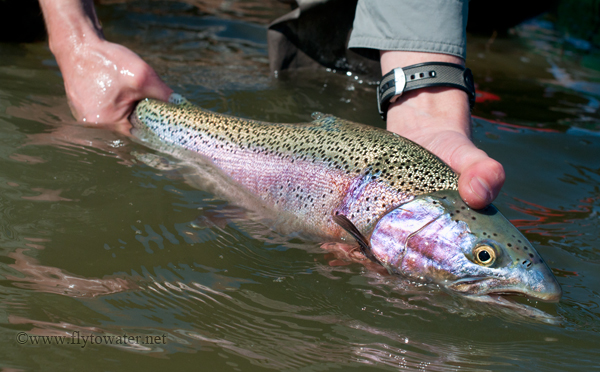
I tend to be far too giddy about throwing the first soft water loops of the year to bother with taking photos. It felt great to feel some aggressive takes this week as rainbows targeted crayfish in the shallows. Some of the strikes were remarkably close to shore and highly visual. I did pause briefly to catalog this trip's typical rod bender:

Spring Stillwater Rainbow

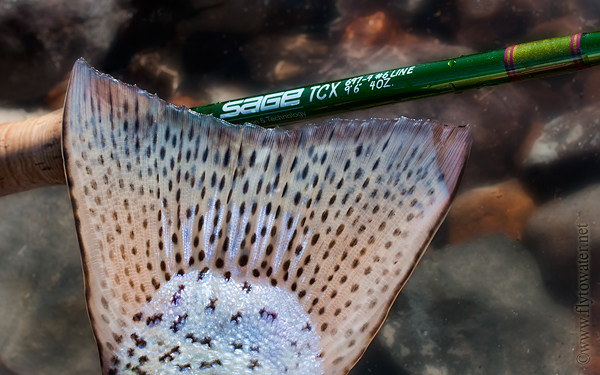
I also enjoyed hucking what has become one of my 2 favorite stillwater rods: The Sage TCX 697-4. Having some extra length at 9-foot 6-inches gives me additional punch for the frequently windy conditions on lakes and impoundments across the West. The TCX has a softer tip than the previous TCR, providing more control, but does not seem to sacrifice anything in the way of distance. The color of the blank is just outstanding too, especially in direct sunlight. The other go-to stick in this category is the Sage Z-Axis 796-4, which adds backbone for bigger fish.

TCX & Rainbow Caudal Fin

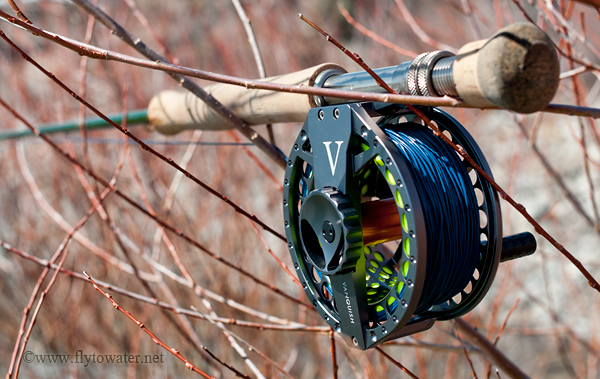
Attached to the TCX on this trip was the Lamson Vanquish 7/8LT - which continues to be a really impressive piece of hardware. Even though the drag system in the lighter version of the Vanquish is not quite as robust as big brother's, I would not hesitate to choose this option for bonefish, snook, or baby tarpon to save wear and tear on the casting arm.

If you haven't seen my review of the 7/8LT, I have product photography and additional thoughts here: LAMSON VANQUISH REVIEW

Sage TCX & Lamson Vanquish 7/8

This weekend will find me chasing more rainbows - although I'm guessing I will be on the stick more often than behind the lens once again. I hope to see a few of you on the water.

Saturday, January 22, 2011

Blue River Fly Company

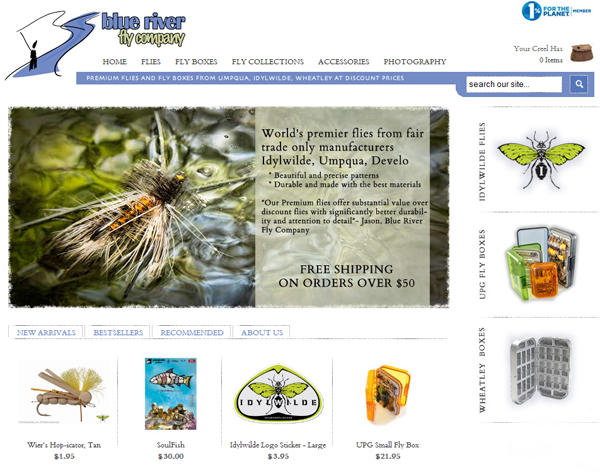
If you haven't had your ear to the ground lately, you might have missed the launch of a new online source for first rate flies, and boxes by both Wheatley and UPG.

BLUE RIVER FLY COMPANY is now up and running, and in addition to providing some great deals they are looking for suggestions about what additional flies and products to carry. Expect videos by Burl Productions, and products from Loon Outdoors and Scientific Anglers to appear shortly.

BlueRiverFlyCo.com

Blue River is great to work with, and I appreciate them using some of my photography commercially on the site.

Fly to Water readers can get a 20% discount through the end of February using the code F2W.

There's good mojo to be had buying from Blue River too, since they are part of 1% for the Planet. Drop in and check things out!