Showing posts with label Bird. Show all posts

Monday, February 18, 2013

Whiteheaded Largebird

Have you ever been so cold that your reproductive regions could be preserved for cryogenic science with no additional cooling required?  One of the great things about wildlife photography is the way in which you can experience abject misery for extended periods of time.

Take this weekend, for example: I stood within 40 yards of a whole convocation of bald eagles for an interval so extensive that whole life cycles of insects were taking place around me. Eggs were laid. Larvae hatched. Eventually these were able to successfully pupate and emerge as sexually mature adults. Temperatures were well below freezing. During this veritable epoch, a vast expanse of fog settled upon the wetlands obliterating all hope of anything resembling a successful photograph.

The day ended.  Total clicks of the shutter: Zero.  This is the part of wildlife photography that isn't always apparent - the time that is allocated to pitiable failure and adult language.

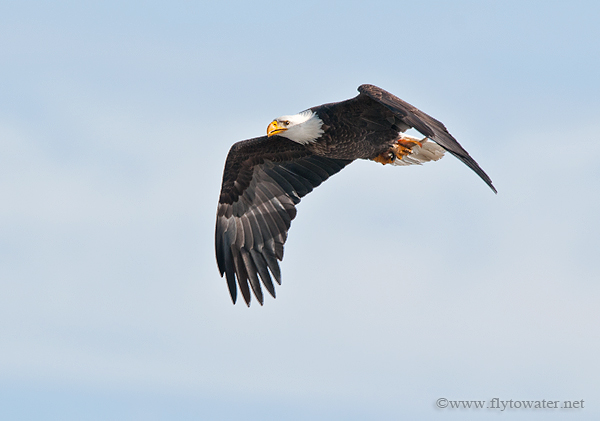
Dawn the following day brought identical conditions.  After a few hours, however, a rapid change took place  and suddenly the air was clear.  Light rained down.  Eagles flew.  Birder's Remorse faded.  Shutters clicked.

Gear Down

Image Details
Nikon D4
Nikon TC17EII
Nikon 400mm f/2.8 VR @ f/4.8, 1/1600, ISO 100

Saturday, February 16, 2013

So Juvenile

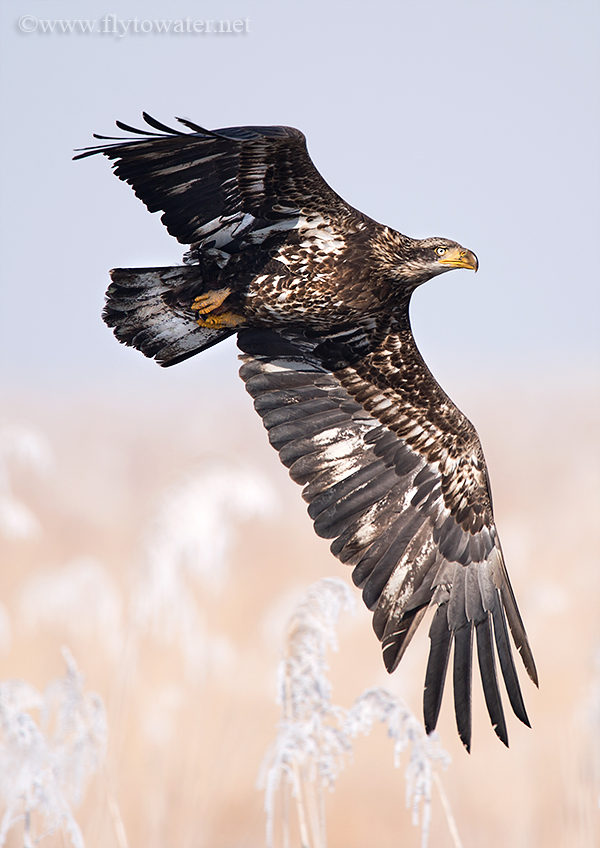
Juvenile bald eagles, a lot like their human counterparts, tend to be a pain in the butt.  Immature birds invariably have chips on their shoulders, and are always ready for a brawl.  Physically a young eagle will appear larger and more imposing than their older counterparts as they have longer flight feathers to help them learn the ropes of aviation.

Since their plumage (especially at the head) lacks the contrast of adults, juveniles are a significant challenge photographically.  Directional, soft light is needed to bring out sufficient detail in the eye to engage the viewer.

Baldies will generally attain their adult plumage sometime in their 5th year, and they are often mistaken for golden eagles during this color phase.

In the wake of numerous, unsuccessful attempts this year to get close enough to the eagles at the right time of day and in favorable light - it was very rewarding to click the shutter on this juvenile today:

Juvenile_Blog

Image Details
Nikon D4
Nikon TC17EII
Nikon 400mm f/2.8 @ f/4.8, 1/1600, ISO 100
Distance to Subject: Approx. 25 yards

Thursday, February 7, 2013

Not Easy Being a Vole

There is something in a man that doesn't love a vole.  Kestrels, on the other hand, eat them like jalepeƱo poppers.

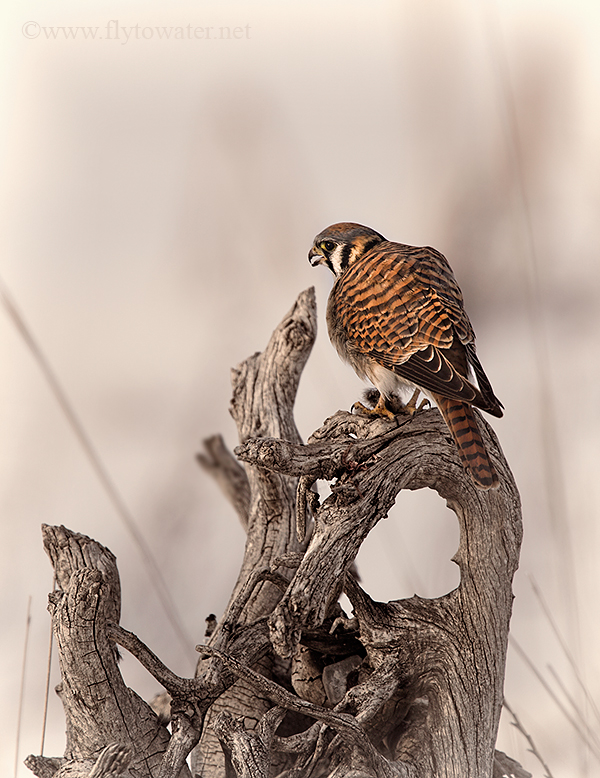
I have seen quite a few successful predations involving these little members of the falcon family, but never one that was initiated from level ground.  The vole emerged from some vegetation about 6 feet away from the seemingly resting bird.  It was a little astonishing to see the kestrel take a few quick strides, leap into the air, and use one quick flap of its wings to extend the jump and land directly on target.

99 problems and vole ain't one of 'em.

Kestrel Predation on Vole

Image Details:
Nikon D4
Nikon TC17EII
Nikon 400mm f/2.8 @ f/4.8, 1/1000, ISO 220

Sunday, February 3, 2013

Stay Frosty

Pheasants believe strongly in a few basic maxims of life.

     1) RUN AWAY!!!

Overall that is the main rule, and they do it well.  Only slightly less emphasized in phez elementary is this:

     2) HOLDING STILL = INVISIBILITY

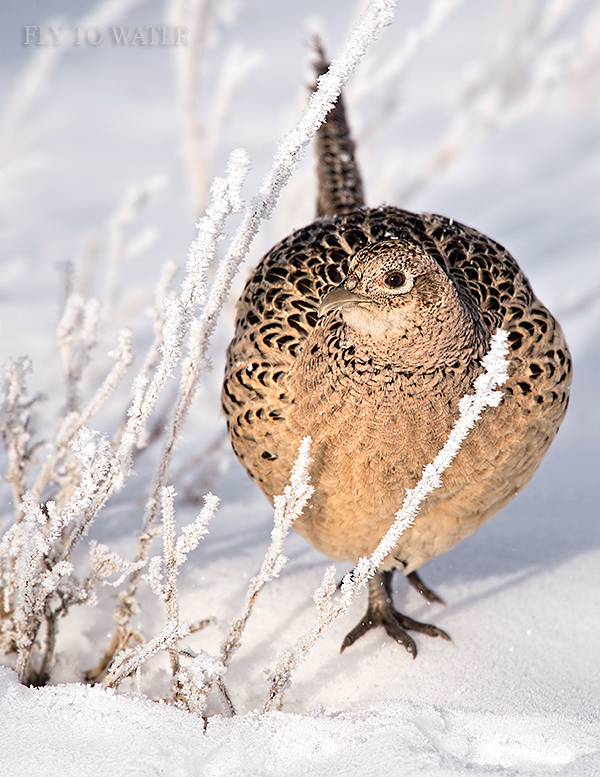
If the unthinkable happens and rule #1 fails, a pheasant will hold still with a bravado bordering on recklessness under the belief that doing so makes them totally invisible.  I always find it pretty comical to see the expression of surprise frozen on a bird's face at this moment.  Probably it's a combination of shock that running did not work as planned coupled with an impending loss of bowel control.  Either way, it's a high alert situation.

Frosty Hen Pheasant - Vert

I think this is probably the closest I've ever been to a wild pheasant with a camera.  The distance here is about 8 yards.  Light will make or break an image like this, and the morning sun was in the perfect position to cast a golden glow on this pretty little hen. 

The year's first birding trip was a lot of fun even though opportunities were scarce despite covering a lot of ground.

Image Details:

Nikon D4
Nikon TC17EII
Nikon 400mm f/2.8 @ f/5, 1/1000, ISO 100

Friday, January 13, 2012

Getting Started in Photography - Part One

Here we are at the beginning of 2012, less than 12 months away from the END OF THE WORLD on December 21st according to the Mesoamerican Long Count Calendar.  As a major socioeconomic force, Fly to Water will now respond to these most weighty of matters by discussing: How I got started in photography.

In the Fall of 2005 I was contemplating a great truth: There were people who could take a quality photograph, and I was NOT one of them.  At the time my definition of "quality" was somewhat limited, but I knew that certain images were engaging, held my attention, and struck me as art.  By contrast my work was as attractive as an uncorked bung hole.

Of course I had the option of going out and buying a nicer camera than the Nikon D70 I was shooting, which would make an immediate difference by doubling the file size of my schlocky snapshots.  Oddly, many people believe in the mathematical formula E = GP², where E is an expensive camera and GP is a constant called "good photos."  I call this the Kopi Luwak delusion: You'd think I was making this up, but there are actual people who profess that because coffee beans are eaten by a civet cat and shat out in the jungle, they make a phenomenal beverage.  Now the civet cat is a fine animal, and my Nikon D70 was a solid camera, but it turns out both can be sorely misused.

This leads me to my point: Dudes are out there selling palm civet dingle berries for $160/lb. 
If you're getting started in photography or looking to improve prior to December's sweet release, consider this:
  • Anyone can take great photos, regardless of what you feel your natural talent/ability level might be.
  • You will need to work at it, with the same kind of dedication that it takes to sell cat crap coffee.
Very early on I came to the realization that successful images happened because of the human elements of photography.  More importantly, I began to discover that many of the qualities generally described as "artistic" were acquirable.  There were principals, camera controls, and techniques which could allow me to get the results I wanted - if I was willing to educate myself.

Step One: Composition

We live in a 3-dimensional world, and from the youngest of ages our minds are conditioned to connect with an environment that involves depth, distance, and perspective.

I was fascinated to learn that the human mind naturally imposes 3-dimensional thinking on flat, 2-dimensional images.  It turns out that fairly straight-forward guidelines exist which help broker the connection with the viewer.

In a general sense, this is called "composition," or the way in which objects are arranged (intentionally and creatively) within the frame. There is nothing about composition that should be left to chance. Inclusion, exclusion, angle of view, position relative to the subject(s), portrait vs. landscape orientation, foreground, background, and many other considerations play an enormous part in how the viewer will interpret a 2-dimensional image.

It took some reprogramming for me to begin seeing in 2 dimensions - actively thinking about how I would use the spacial relationships in the frame to hold attention rather than create distraction.

The topic is too broad to cover in a blog post, but here is the take away: Regardless of your equipment, there is a FREE way of making your photos more engaging with simple compositional techniques that can be learned and practiced at home.  I started by reading Photographic Composition, and Brenda Tharp's excellent Creative Nature and Outdoor Photography - both available on Amazon for about $15 bucks.

Read up before 12/21/12, when it will be human sacrifice, dogs and cats living together... MASS HYSTERIA.  If this has been helpful, drop me a line.  I've got a few more pre-cataclysm thoughts brewing.

Sunday, January 1, 2012

Chasing Quail

When all else fails...NEW TACTICS.

Around Thanksgiving I wrote HERE about a covey of jittery, rural quail that have unabashedly given me the bird for years.  This group and I have a certain understanding: I foolishly attempt to approach them, and they in turn show me their asses at 100 yards.  It's not an equitable arrangement. 

As the new year approached, I began wondering if a tried and true upland hunting technique - using a blocker - might work on the photo front.  Thinking back, I believe my wildlife photography has benefited greatly from a lifelong background as a sportsman.  Understanding animal behavior patterns, body language, vocalization, and other factors seems to provide me at times with an edge behind the lens.  The idea of pushing/blocking upland game is not new, but shotguns have an effective range of about 50 yards - a distance that needs to be cut in half with a camera.  Still, it was a concept that seemed worth testing out.

I gave Jason Morrison a call, and the game was afoot.  Jay is a guy who I knew had the skill to nail a fleeting opportunity that would last only seconds.

Arriving at the scene, an old farm in Northern Utah, I was disappointed to find that the birds did not pass the night in their usual spot.  It was a downer, because the golden light of morning created a perfect stage upon which there were no performers. Preparing to seek other possibilities, we suddenly noticed the covey near an old corral that had not seen use in ages.  It was at this point that long experience with upland birds kicked into gear, and I knew even before our approach that the situation was ideal.

It was my feeling that the covey, upon seeing my voluminous biomass heading in their direction, would sprint along the corral's contour for some 75 yards.  Here, they would reach a dead end and begin flying up onto some aged fencing and an old, rock wall.  Doing so would give them an escape route to the wheat fields beyond.  If Jason could position himself near this natural collection point in advance, he would have front row seats as 30 quail paraded past him at about 8 paces.

Morrison took the road less traveled, going far out of his way and remaining concealed from view until he eventually circled back about 20 minutes later and got into position.  I knew the birds wouldn't let me get close, so in the meantime I dug out my Nikon TC20-EIII, a 2x teleconverter that would double the focal length of my lens.

Getting the ready signal from Jay, I emerged from cover and vectored towards the corral.  I say "vectored" because it's something of an art to advance on animals without appearing as if you are necessarily headed directly at them.  It's one of those "look casual" things.  As the pusher, I carefully observed the birds in the covey to watch for signs of nervousness, and paced myself to avoid a flush.  The quail moved deliberately, but not in a panic, towards the blocker position.  A few stragglers occasionally tried to double back, and afforded me several medium distance shots from perhaps 20 yards.

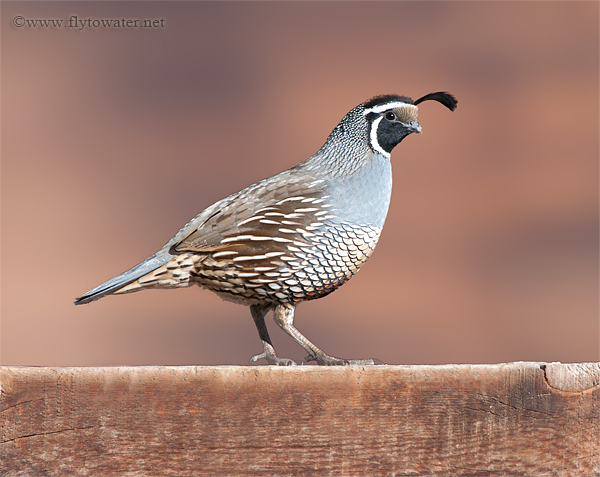
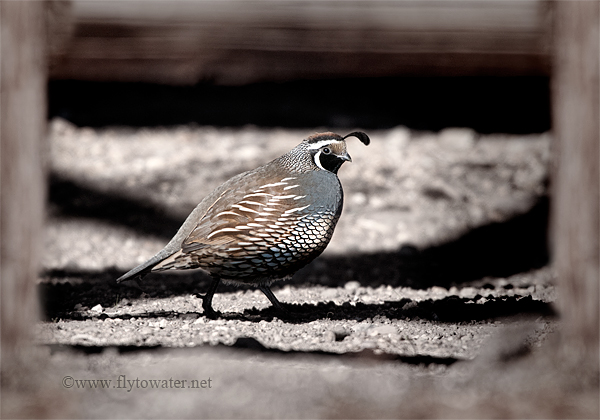
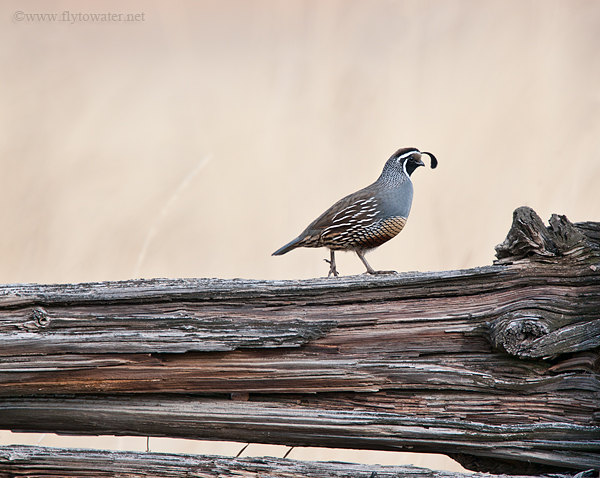
Male California Valley Quail - Fence Rail

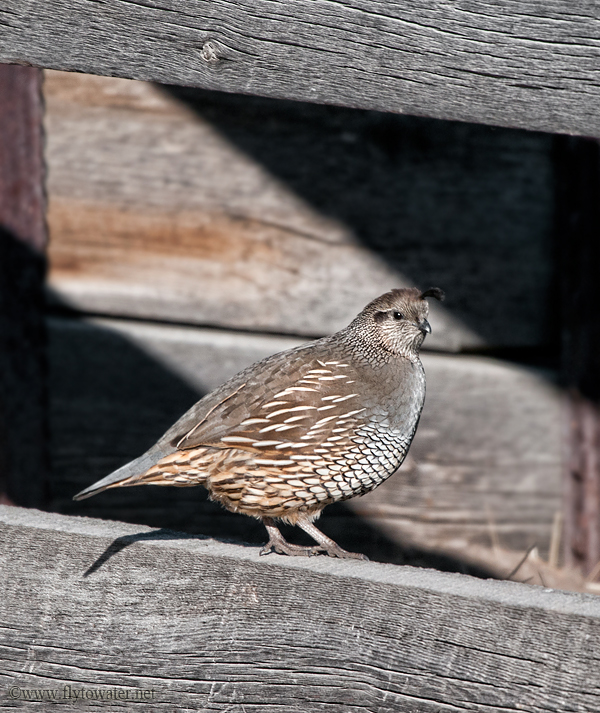
Female California Valley Quail - Barn Wood

At one point I was able to lie down and capture a unique image as this male passed into a natural frame created by the bottom rail of the corral and 2 posts.  Shadows from the fencing formed a number of leading lines, drawing the eye towards the well-lit subject:

Male California Valley Quail - Framed by Old Fence

The day nearly ended in tragedy as JayMorr encountered a rare, silent killer: A quail stampede. 60 tiny feet, possibly descended from the velociraptor's, bore down on the blocker position.  From my perspective the whole thing wound up looking like some kind of avian flash mob dancing a Spanish Flamenco around Jason.  True to form he did not miss the opportunity.  Be sure to drop in and see some of his fantastic imagery - shot from 8 paces (HERE).  If you haven't attempted to photograph wild, rural game birds - it's difficult to articulate how extraordinary a situation like this really is.  The aggregation of great light, point-blank subjects, correct position relative to the sun, and very little time to work with all combine to make Jay's photographs remarkable.  It was the ideal way to spend New Year's.  A big congrats to Morrison on his first wild California Valley Quail images, and all the dues that were paid leading up to the moment.

Nikon D300
Nikon 400mm f/2.8 VR - f/8, 1/320, ISO 400
Nikon TC20-EIII Teleconverter
Distance to Subjects: 60 Feet/20 Yards

Tuesday, December 27, 2011

Devil Birds

I had been hiking for a while now.  The ambient temperature was 14° F (-10° C), which was comfortable.  A few years ago my outdoor wardrobe experienced some natural base layer enhancement courtesy of merino wool, which is a miracle fiber.  Like your garden variety wool it insulates even when wet, but against the skin it does not itch and feels like fleece.  Inexplicably it can also stave off odors for a remarkable amount of time, and it breathes extraordinarily well.  I was glad to have my Icebreakers on this occasion.  Incidentally, if you are one of my fly fishing readers, merino socks by this company are the dog's bollocks (meaning badass in the UK) for cold weather wading.

Chukar partridge were my goal for the day.  Early in the Fall it's often possible to locate a covey by listening for calls, but typical of this time of year it was dead quiet.  Wild birds soon realize their chatter is giving them away, and they start dishing out the silent treatment.

Hiking in the steep, rocky talus that chukars love with a 14-pound camera rig offers a pucker factor of about 9.0.  Opportunities can be so unexpected and fleeting, I've never been able to successfully make use of a tripod, monopod, harness, or pack.  It's all free-hand.  At double the weight of a typical shotgun, and with the awkward size/shape of a big telephoto, the visual is like watching someone Riverdance on a cliff face while cradling a huge baby.

Presently due to insubordination on the part of my pulmonary system I stopped to catch a breather in a large boulder field.  About 3 weeks ago I acquired the felicity of walking pneumonia and am still feeling the effects.  After a minute or two, what I can only describe as a chukar whisper seemed to emanate from the rocks to my immediate left.  The sound was barely audible, and far more subdued than I had ever heard before.  My thought was that the call must have been more distant and I'd experienced a sound effect in the strewn boulders.

Following a few seconds of questioning the wisdom of combining thin air with cough syrup, I heard it again - "chuk-chuk."  There were partridge about, and they were close.  Really close - within feet.  Over the last 25 or so years, I've hiked, hunted, scouted, and photographed in chukar habitat hundreds of times, and I can't say that I've ever managed to get nearer than 15 yards.  Until now.

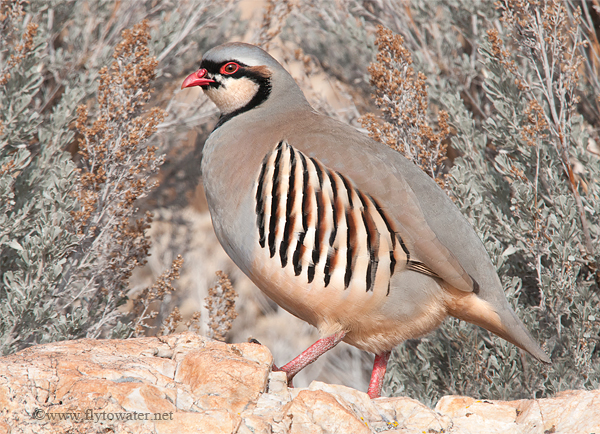
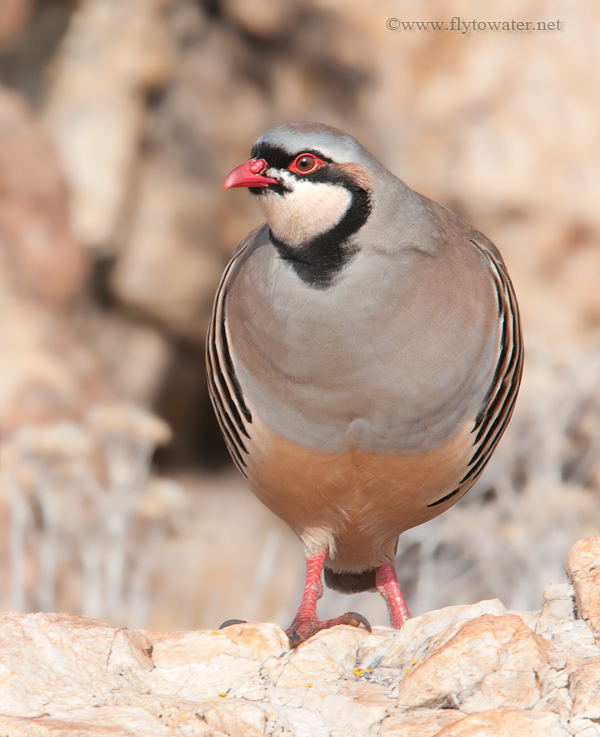
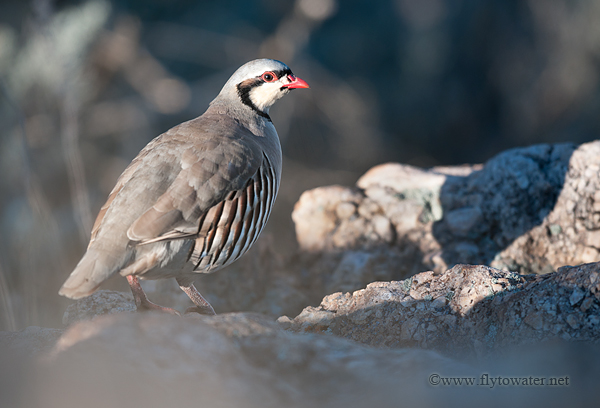
 Wild Chukar Partridge - Spitting Distance

18 feet in front of me a mature, well-marked bird hopped up on a rock and was positioned ideally to catch the morning sun.  Had I not been forewarned by the muted calls, which enabled me to raise my lens just in time, I have no doubt a flush would have been instantaneous.  As it was, I captured a short series of images from spitting distance.  At this range I believe my Sitka Gear Open Country camouflage probably made a huge difference, allowing me blend in under point blank scrutiny.

See No Evil

This was a great way to finish out 2011 - with a humbling opportunity that I was privileged to see through the viewfinder. 

Wild Chukar Partridge - 6 Yards
Nikon D300
Nikon 400mm f/2.8 VR - f/8, 1/320, ISO 400
Distance to Subject - 6 Yards/18 Feet

Monday, December 26, 2011

The Eyes Have It

"Look at me when I'm talking to you!"

If you are a guy of they XY chromosome persuasion, chances are you have had this type of exclamatory remark flung in your direction. Due to a vast conspiracy between extroverts and chick flick producers, eye contact became an important, non-verbal communication element at some point in history.

While information technology professionals have been fighting this alarming and intrusive trend for decades via non-violent, downward gazing - such efforts have done little to stop the insanity.

Looking into the eyes establishes a connection.  Similar body language is evident even in animals, where the direction of a stare or glance can have much deeper social meaning. 

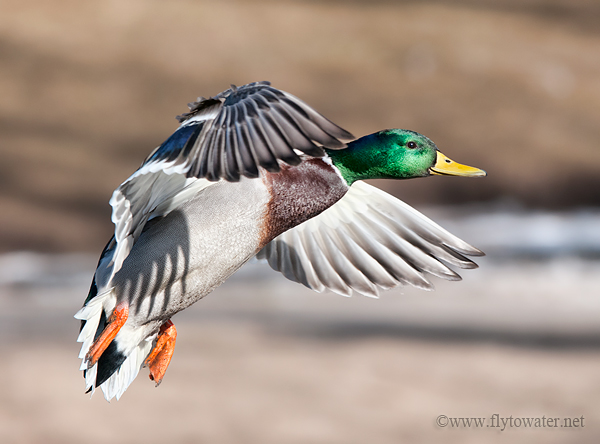
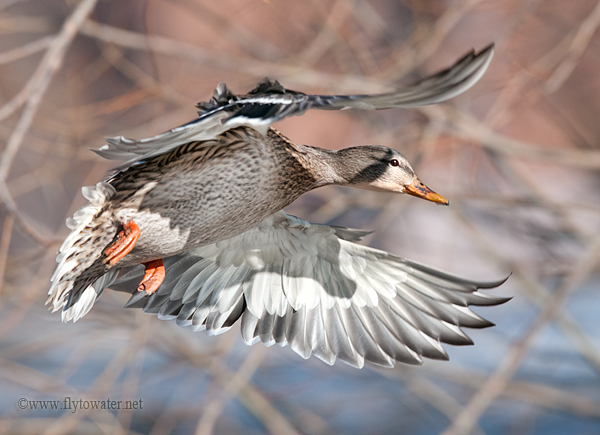
In wildlife photography, creating a linkage between the viewer and the image is paramount.  Eyes are a critical component of the subject in this regard.  Aside from intentional, artistic abstractions - successful images must capture the eye in sharp focus and without motion blur.  This remains true regardless of distance and whether you are capturing a tight shot or broader environmental portrait.

Mallard Drake Glide Path

It can be Hell's own fun tracking focus on the eye of a fast-moving bird while experiencing a fit of the galloping shivers.  It's a perishable skill that takes practice.  If you're looking to improve your technique, my suggestion is to find a location with a lot of mid-sized birds like seagulls which tend to congregate in groups and fly around in circular patterns.  Use the same gear you take into the field, and rehearse focusing on the eye.  You might get some odd looks bombing photos of gulls, but it's a small price to pay to avoid the opprobrium of eye blur when it counts.

Mallard Hen on the Wing

Don't settle, like Kate Hudson did for Chris Robinson.  If your intent is not an abstraction of some kind - the eye simply needs to be sharp.  Make sure not to confuse missed focus with motion blur caused by a shutter speed which is too slow.  Waterfowl will usually have some wing blur at 1/1250, with action freezing well at 1/1600.  As a starting point select the camera's shutter priority mode on one of these two settings and adjust as conditions require.

Happy Holidays - and thanks for reading during 2011!  I wish everyone a fantastic New Year.

Nikon D300
Nikon 400mm f/2.8 VR - f/5.6, 1/1600 (8x Optical Magnification) - Hand Held
ISO 400
Distance to Subjects: 20 yards/60 Feet

Saturday, December 3, 2011

Quote the Chukar

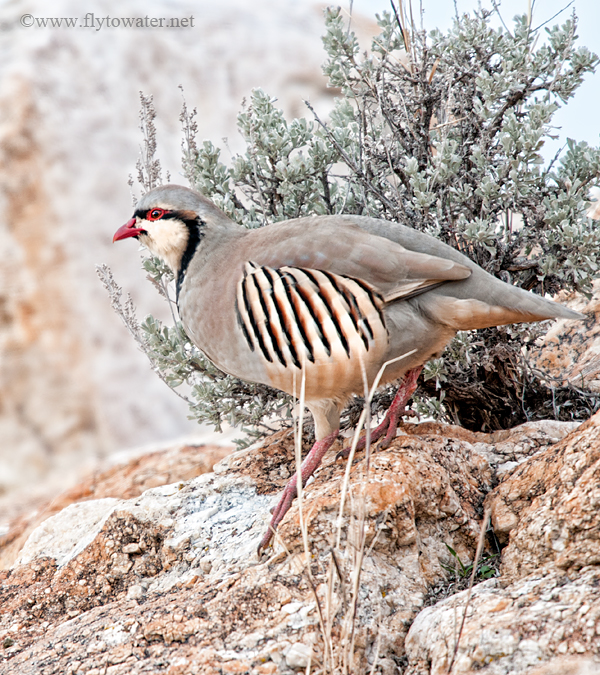
The chukar partridge (Alectoris chukar), is so named due it's distinctive call which sounds like "chuk."  Native to locations in Asia such as the Himalayas and Nepal, it should come as no surprise that these little birds enjoy rugged terrain.

To describe the habitat chukars prefer as "steep" is to say that getting kicked in the gonads is bothersome.  Somehow it doesn't adequately sum up the experience.

Hunters and photographers of these partridge can also be identified by their calls, which happen to rhyme with "chuk."  It has been said that a person hunts chukars for the first time out of curiosity, and thereafter for revenge.

To me, no other game bird embodies the qualities of a survivalist quite like them.  Living in the high desert foothills is a game of extremes.  Water and food are scarce, and predators abound.  The chukar is well suited to a harsh life, and is tremendously challenging to photograph.

Infiltrating a covey with 20+ sets of keen eyes, each pair honed by daily existence as a prey animal, can be an exercise in futility.  Add rocky, vertical geography to the mix and it's downright sporty.  If those were the only considerations involved, life would be good.  Unlike the hunter, the photographer also needs to make it all happen during ideal lighting conditions and be positioned on the sunny side of the bird as the opportune moment arrives.

A truly complete image is rounded out by some supporting environmental elements within the frame, helping to add context to the scene.


Some native grasses in the foreground, sage brush in the immediate background, and the ever-present rocks so common to a chukar's stomping grounds help complete the story.

Distance to Subject: 45 Feet/15 Yards
Wednesday, November 30, 2011

Taking to the Valley

No religious extremist has ever been as fanatical about a concept as quail are over the posting of sentries.  In covey society, forgetting to have someone stand guard is like wearing an argyle sweater vest - it's the unthinkable.  Spanish Inquisitors took Christianity far less seriously, and appear slapdash in comparison to the diligence of these feathered lookouts.

Gambel's Quail - Rural - Old Fence


Where I live, quail are somewhat of a dichotomy because they adapt well to urban settings.  In residential areas birds are semi-tame as they move from feeder to feeder, pausing only to avoid the occasional obese house cat crossing their path.  As subjects of photography, these city dwellers are far from ideal.  Photos of game birds perched on a Prius or crossing a well-manicured lawn don't represent the proper wild, upland heritage.

Unfortunately for me, quail living in a rural setting are more paranoid than a methamphetamine addict that's just downed a double espresso and Red Bull frappĆ©.  Constantly contending with numerous raptors, coyotes, bobcats, skunks, racoons, snakes, and other predators - the wild variety invariably appear to be on the verge of a psychotic break.

Upon seeing a hominid in the distant atmospheric shimmer, a rural quail's eyes will protrude slightly out of the head and cause a jolt of adrenaline to surge to the wings. Any attempt to approach to within 100 yards will result in the wholesale evacuation of the premises.
Last year I scouted a really nice farm that had both a healthy quail covey and some classic upland habitat including some fences made of nicely weathered wood.  My hope was to get a few shots of these birds in an iconic setting, but despite making 4 separate attempts, the covey never let me get closer than a football field.  Even with a long lens, my operating distance on a subject this size is about 25 feet.  I wasn't even in the ballpark.
Last weekend I visited the location again.  It's a 2-hour round trip, so I had now driven a total of about 10 hours and this was my 5th day in what had so far been a fruitless attempt to stalk this group of quail.  I was immediately excited as I glassed an area and saw my quarry disappearing behind a 4-foot-high fence.  This was the obstacle I needed to screen my approach from the watchful eyes of the 20 covey members.  In full camo and in max stealth mode I performed what I thought was a flawless stalk and got into position.  Somehow they busted me yet again!  I can only surmise they heard me, but upon peeking around the fence all the birds were in the air 200 yards away heading for an immense field of cattails...
Except one.  The sentry male had taken up the rear guard position, perched on a section of broken fence.  In a fleeting moment of opportunity I made a digital copy of him from about 25 feet away.  I was glad to finally glimpse this this well-dressed gentleman through the viewfinder.

Gambel's Quail - Rural - Barnwood

Monday, November 28, 2011

Preening

Preen - transitive verb
  1. To dress or smooth oneself - to primp.
  2. To groom
  3. A tactic used by the female in a dating arrangement to grievously delay commencement of an evening's planned activities - to lag.
OK, so #3 isn't verbatim from the dictionary - but it falls within the bounds of literary license.

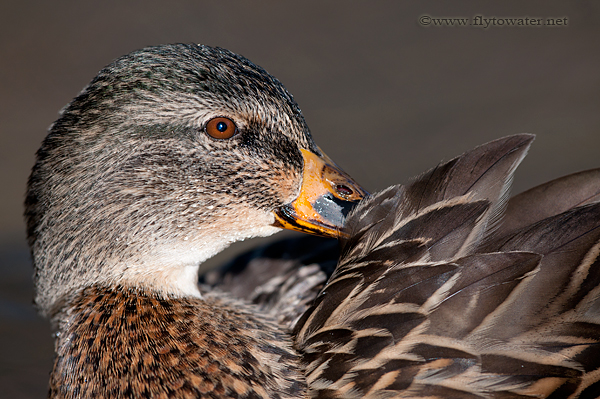
I couldn't help but notice in the process of capturing this image of a preening mallard hen that a rather impatient-looking drake was paddling back and forth a short distance away.  In the land of ducks, he was essentially in the formal entry checking his watch every 30 seconds because his reservations at the corn field clear across town were in 10 minutes.  Of course he had shown up half an hour earlier at the agreed upon time, but had failed to take into account that preening can only begin upon his arrival.  Few things, after all, are more deflating to a lady than a stale preen job.

Preening Hen

I was fortunate to have this hen swim very near to me during a window of wonderful light on Saturday.  The distance to her from the end of my camera lens was perhaps 6 feet.  Shooting at 8x optical magnification, what you see here filled the frame.

After she was all primped:

Hen Mallard

Sunday, November 27, 2011

To Flush or not to Flush

...that is the question.


Shooting through foliage is usually not ideal, but chukar partridge are fiendish birds with a natural inclination toward sneakiness.  It is not uncommon for a photographer to make loud, rattling sounds with the throat that carry at least as far as alpine yodels after being very close to a large covey and getting no shots whatsoever.

The unpredictability of wild subjects will at times preclude the ability to move and recompose.  In these cases, foreground foliage can be used as an element to draw the viewer to an area of crisp focus.  When using this technique, it's critical to achieve a high amount of detail in the area of interest.  Catch light in the eye and sharpness throughout the bird's mask and head grab attention, while also leaving something to the imagination.

Despite spending the morning in the general proximity of around 40 birds, this was the only opportunity that panned out.  I'll be chasing them again.


Friday, November 11, 2011

11-11-11

At one time in my younger days I hunted upland birds without a dog, and consequently went about life largely unfulfilled.  Part of this may have been due to the fact that my father, in response to vehement requests for a sporting breed, obtained a beagle/fox terrier mix.  In the field this dog's primary talent was turning into a linear motion blur and racing off until he was concealed by the curvature of the Earth.

One can only speculate as to why Dad chose to deprive his posterity of gun dogs, when he himself was raised with a brace of Brittany Spaniels.  My theory is that it had something to do with excessive intake of maple nut ice cream - a bastardized confection he purchased with reckless abandon during my childhood.  Essentially the frozen dairy equivalent of fruitcake, maple nut should ideally be re-gifted during the holiday season and never consumed.  Yet eat it my father did, and in so doing caused irreparable damage to the petulla oblongata, or pet-selecting portion of the brain.

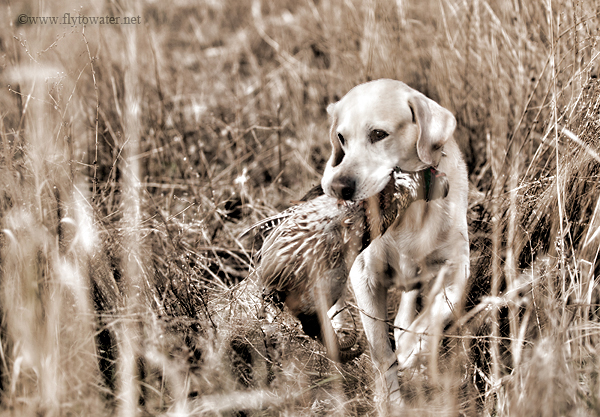
Regardless, I soon reached an age when I could apply the guillotine choke when parental objections were raised and immediately set about the procurement of a proper canine companion.  Dogs in the field have since become the element of upland hunting I enjoy the most.

Retrieve

It was great to be out on a sunny, Fall day.  Thanks to the pups a few wily phez found their way into the vests along with a limit of chukars.  It doesn't get much better than putting boot to cover with a 4-legged friend leading the way and a well-balanced over/under in hand.  11-11-11 worked out nicely.

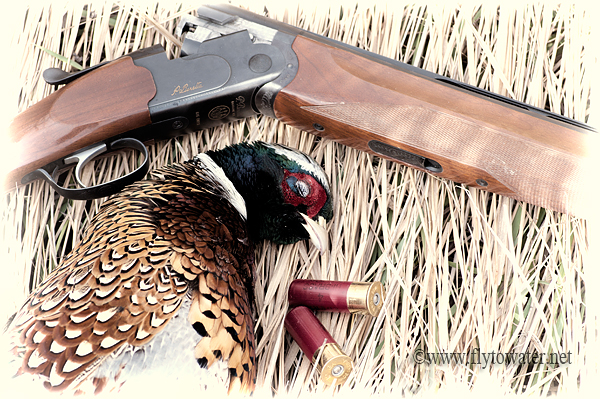
Wild Ringneck & Beretta 686 Onyx O/U

Sunday, January 23, 2011

Scouting

A few wisps of blue sky showed themselves occasionally this weekend, and I spent some time scouting locations for raptors. Aside from getting to watch a great blue heron spearing voles with amazing accuracy one evening after the light had faded, nothing noteworthy really took place.

Utah's Wasatch Front experiences a widespread temperature inversion during the winter. This phenomenon causes an enormous pollution cloud, even larger than the one emitted by Al Gore's personal residence, to hover over the valley.

Spending any time outdoors under these conditions is akin to huffing oxides of nitrogen directly from the exhaust pipe of a 1970 AMC Gremlin.

Occasionally a storm of sufficient strength blows through and sweeps the toxic atmosphere up into the jet stream, where it is often mistaken for Icelandic volcano ash and grounds all flights in France.

We experienced one such storm system late last week and had glorious, clean air for the weekend. It was nice just to be outside. I didn't get any images that I'd consider "keepers" but a few birds were in the air and I dusted off the shutter to get in the groove.

I'm hoping the next month or so brings some additional opportunities.

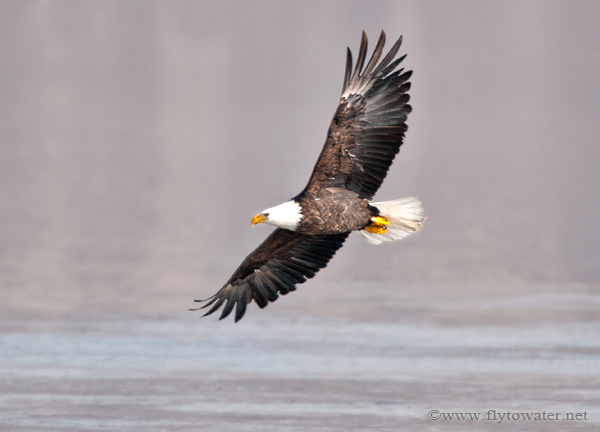
Bald Eagle Sight Fishing

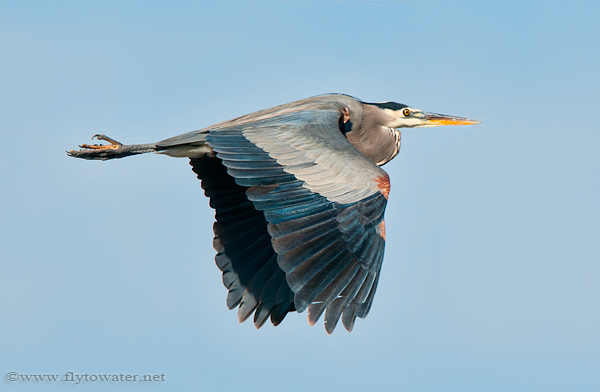
Great Blue Heron in Flight

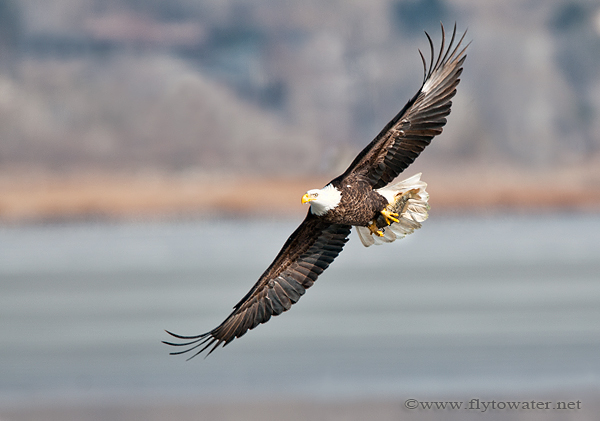
Bald Eagle with Carp Dinner

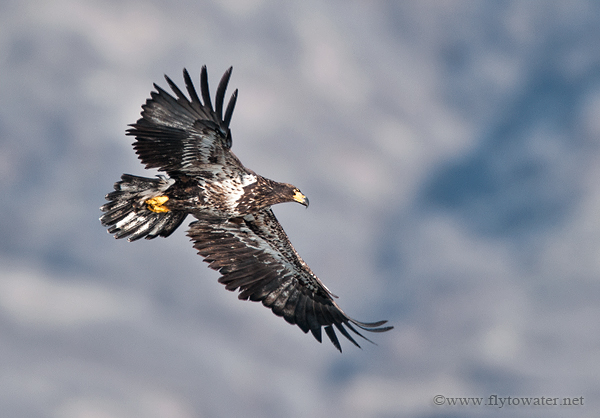
Immature Bald Eagle

Eagle Blue Sky

Sunday, January 2, 2011

First Click - 2011

By way of follow up to my last blog post, I've received a lot of e-mail asking for specific tips about photographing game birds, such as the chukar partridge.

I wish I could say it was as easy as picking up a 600mm f/4 lens with a nice window mount, whereupon it becomes immediately possible to capture 5-star images from your climate-controlled SUV.

If it's been a while since you've...
  • Gone out in temperatures cold enough to freeze the balls off a brass monkey
  • Done a "1-legger" down a 3-foot-deep rock fissure drifted over by snow, nearly breaking an ankle in the process
  • Torn your trapezius
  • Sat motionless until cramps were galloping up your legs like Charlton Heston's chariot in the movie Ben-Hur
...then I recommend taking up wild game bird photography for a real treat. Each of the items on that list happened to me yesterday. Luckily, I did manage to obtain exactly 1 photograph for my troubles - which is above average for a typical day.

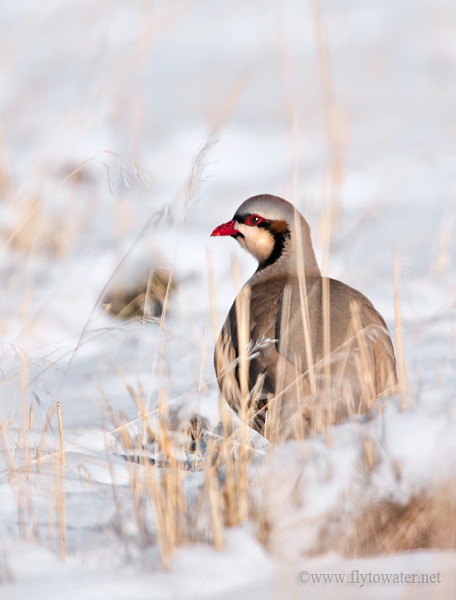
Checking His Six

The basic recipe for success:

Scouting: The process begins with a scouting trip (or trips) into likely habitat. It's important to locate game birds without disturbing them initially, at least if photography is on the agenda. A decent pair of binoculars and a spotting scope are great tools that help cover a lot of country.

Patterning: Once you have located a population of birds, you want to watch them for a while. It's quite common for these animals to have a routine. You may find a watering hole, food source, spot where the sun hits first thing in the morning, or travel route that game birds use regularly. During this period of observation, you want to take note of lighting conditions and possible hiding spots. Typically you will want to be in a position where your subject is being lit from the front or side, which needs to be taken into account.

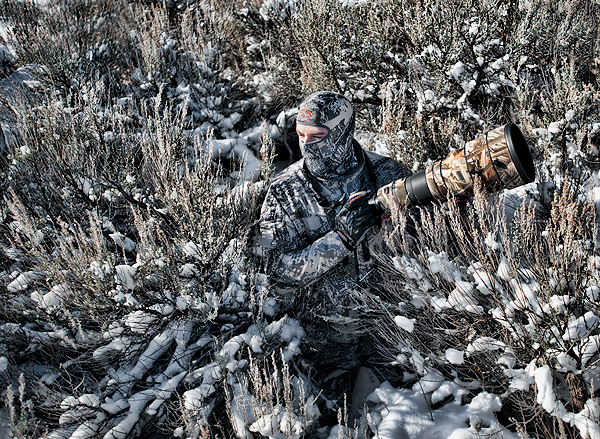
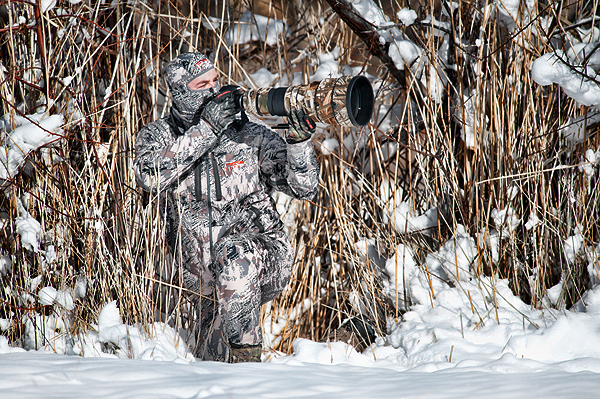
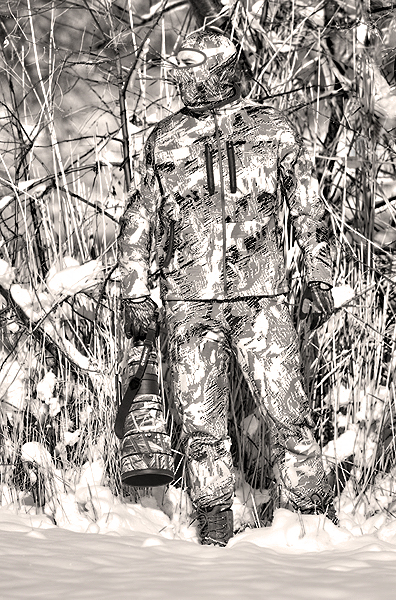
Concealment: While non-avian predators and most big game animals see primarily in black and white, birds see in color. Camouflage becomes an important accessory, and it's a good idea to have a few options available to match various types of terrain. My favorite for chukar habitat is the Open Country lineup from Sitka Gear. This pattern has been specifically designed and researched based on how animals see, as opposed to most products that are based on human vision.

I also use a LensCoat to hide the hardware. These are made of neoprene and also provide some protection from dings and scratches in addition to breaking up the outline of the equipment. LensCoat products are available for a wide variety of common camera lenses.

Caught on Film

Waiting: Get into position prior to the time you have observed birds using the location in your scouting. In my experience, wind is less of a factor with birds than it is with mammals. Make sure to dress warmly in cold temperatures, because sitting around doesn't create a lot of body heat. Stay alert and be opportunistic - things will usually not unfold exactly as planned. Knee pads are a good accessory in rocky terrain in case you have to move around while keeping a low profile.

Reeds

That's the basic formula. Lather, rinse, and repeat.

Thanks to JayMorr, who took the portraits of me used in this post. His blog has additional images and comments about getting TO the shot, which is the main ingredient in getting the shot when it comes to critters.

In Plain Sight